
🧘♀️ Journaling For OCD Relief: Writing Your Way Out Of Intrusive Thought
Understanding OCD and the Power of Expression
What OCD Really Is: Beyond the Stereotypes
Obsessive-Compulsive Disorder (OCD) is more than being tidy or particular—it’s a cycle of intrusive thoughts and compulsive behaviors that can feel impossible to escape. People with OCD often experience repetitive, distressing thoughts (“What if I harm someone?”) followed by compulsions to neutralize the anxiety (“I must check repeatedly to make sure I didn’t”).
Why Intrusive Thoughts Feel So Overwhelming
Intrusive thoughts hijack the brain’s fear center, creating an intense emotional reaction. These thoughts stick because the brain mistakenly labels them as dangerous. Suppressing them only strengthens their hold. The key lies in expression and acceptance, not resistance—and journaling provides the perfect outlet for that.
How Writing Helps the Brain Process Anxiety
Journaling For OCD Relief. When you put words to what’s swirling in your mind, you activate the rational prefrontal cortex. Writing down fears externalizes them, reducing emotional charge and helping you observe thoughts with more objectivity. Journaling becomes a bridge between emotional chaos and cognitive clarity.
The Science Behind Journaling and Mental Health
The Psychology of Externalizing Thoughts
Psychologists describe journaling as “mental decluttering.” It helps your mind offload emotional weight by turning thoughts into tangible language—something the brain can evaluate, contextualize, and ultimately, let go of.
The Role of the Prefrontal Cortex and Emotional Regulation
Neuroscientific studies show that expressive writing increases activity in the prefrontal cortex—the brain’s center for logic and decision-making—while calming the amygdala, which governs fear. This shift reduces anxiety and creates a physiological sense of calm.
Studies Linking Journaling to OCD Symptom Reduction
Research published in Behavior Therapy and Experimental Psychiatry reveals that structured journaling combined with exposure therapy significantly decreases intrusive thought frequency. Writing helps patients reframe cognitive distortions and reduce avoidance behaviors.
How Journaling Can Help You Manage OCD Symptoms
Identifying and Labeling Triggers
Journaling allows you to spot recurring themes or triggers—specific times, situations, or emotions that intensify obsessions or compulsions.
Creating Distance Between You and Your Thoughts
When written on paper, thoughts lose immediacy. Seeing them as words rather than inner voices helps you detach from mental loops and recognize that you are not your thoughts.
Recognizing Compulsion Patterns Through Writing
Regular reflection reveals behavioral cycles: triggers, compulsions, and temporary relief. Awareness is the first step to breaking this loop.
Tracking Progress and Building Awareness
A written record of your journey showcases growth over time. You’ll begin to notice that intrusive thoughts occur less often—or at least, hold less emotional power.
Step-by-Step Guide: Journaling For OCD Relief
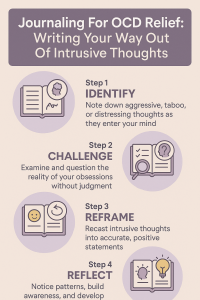
Step 1: Create a Safe Writing Space
Choose a quiet, comfortable environment where you can write freely without fear of judgment or interruption.
Step 2: Choose Your Journal Type (Digital vs. Paper)
Both work—choose what feels most natural. Physical journals can feel grounding, while digital ones offer privacy and convenience.
Step 3: Set an Intention Before You Write
Ask yourself: “Am I writing to release, understand, or reframe?” This guides your focus and helps you stay mindful.
Step 4: Use Prompts to Guide Your Reflection
Instead of free-writing aimlessly, prompts provide direction. Try:
“What fear keeps showing up lately?”
“How can I respond differently to intrusive thoughts?”
“What truth do I know that OCD tries to make me forget?”
Step 5: Don’t Edit or Judge What You Write
Perfectionism fuels OCD. Let your words flow without censoring them. Grammar doesn’t matter—authenticity does.
Step 6: Reflect and Release
After writing, take a moment to breathe. Acknowledge that the act of writing itself is the healing process, not the product.
Step 7: Review Your Entries Periodically
Looking back can reveal patterns of progress and help you celebrate wins, no matter how small.
10 Effective Journal Prompts for OCD Relief
Thought Identification Prompts
“What thought am I resisting today, and why?”
“If my thought were just a cloud, how fast could it pass?”
Exposure and Acceptance Prompts
“What would happen if I allowed uncertainty for five minutes?”
“What’s one fear I can face without reacting?”
Gratitude and Mindfulness Prompts
“What moment today made me feel calm?”
“What am I thankful for that OCD can’t take from me?”
Self-Compassion and Healing Prompts
“How can I speak to myself with kindness today?”
“What would I tell a friend struggling with this same thought?”
How Often Should You Journal for OCD?
The Power of Daily Consistency
Aim for 10–15 minutes a day. Journaling is most effective when it becomes a consistent ritual rather than an occasional exercise.
How to Avoid Turning Journaling Into a Compulsion
If you feel anxious not writing, or you rewrite entries repeatedly for reassurance, pause and recalibrate. Remember—the goal is expression, not control.
The Connection Between Writing and Mindfulness
How Writing Cultivates Present-Moment Awareness
Writing slows down thought flow, helping you observe rather than react. Each sentence becomes a mindful anchor, grounding you in now.
Mindful Journaling vs. Rumination
Mindful journaling focuses on observing thoughts without analyzing them to death. It’s not about solving problems—it’s about letting go.
Combining Journaling With Therapy for Maximum Relief
How Therapists Use Journals in ERP and CBT
Therapists often integrate journaling into Exposure and Response Prevention (ERP) or Cognitive Behavioral Therapy (CBT) as a tool to track exposures, monitor progress, and identify triggers.
Sharing Insights With Your Mental Health Professional
You don’t have to share every entry—but summarizing insights can help your therapist adjust treatment strategies effectively.
Common Mistakes to Avoid When Journaling for OCD
Writing to seek reassurance (“Did I do something wrong?”)
Overanalyzing every detail instead of observing feelings
Treating journaling as a test of moral worth
Skipping reflection after writing
Keep your journal sacred—a place for truth, not perfection.
FAQs About Journaling for OCD Relief
Q1: Can journaling make OCD worse?
If used obsessively, yes. The key is to write to observe, not to fix. Use mindfulness to prevent journaling from becoming another compulsion.
Q2: How long should I write each day?
10–20 minutes daily is ideal. Quality and honesty matter more than length.
Q3: What should I do if writing triggers anxiety?
Pause, breathe, and remind yourself: Feeling discomfort means you’re processing, not failing.
Q4: Is digital journaling as effective as handwriting?
Yes. Choose what feels more comfortable and consistent for you.
Q5: Can journaling replace therapy?
No—but it’s a powerful supplement. Think of it as mental training that enhances professional therapy.
Q6: What type of journal is best for OCD relief?
A private, distraction-free medium—whether paper or app—that feels safe and inviting.
Conclusion: Writing as a Path to Mental Freedom
Journaling for OCD relief isn’t about perfection—it’s about presence. Each word you write weakens the power of intrusive thoughts and strengthens your self-awareness. Over time, writing becomes more than a coping mechanism—it’s a daily act of self-liberation.
Through patience, consistency, and courage, you can truly write your way out of intrusive thoughts—and back into peace.
🧠 External Resource: Learn more about OCD journaling techniques at the International OCD Foundation (IOCDF).


