
Role Of Gratitude And Acceptance In OCD Recovery: A Transformative Approach to Healing

Understanding OCD: A Brief Overview
Obsessive-Compulsive Disorder Explained
Role Of Gratitude And Acceptance In OCD Recovery: Obsessive-Compulsive Disorder (OCD) is a mental health condition marked by repetitive, intrusive thoughts (obsessions) and compulsive behaviors performed to reduce anxiety or distress. These thoughts often center around fears of harm, contamination, morality, or perfectionism. While OCD manifests differently for everyone, its defining feature is the cycle of distress and temporary relief—an exhausting loop that limits one’s ability to live freely.
OCD isn’t a character flaw or a lack of willpower; it’s a neurobiological and psychological condition rooted in overactive anxiety circuits and rigid thought patterns. Understanding this foundation is key to approaching recovery with compassion and realism.
The Emotional Toll of OCD
Living with OCD can be emotionally draining. The constant mental battles often give rise to shame, guilt, and hopelessness. Many sufferers feel isolated, misunderstood, or even defined by their condition. Over time, the need for certainty and control can overshadow joy and spontaneity, leading to emotional fatigue.
This emotional burden highlights why healing OCD isn’t just about symptom reduction—it’s also about cultivating emotional flexibility, self-acceptance, and gratitude for one’s inner resilience.
Traditional OCD Recovery Approaches
Cognitive Behavioral Therapy (CBT) and ERP
The cornerstone of OCD treatment is Exposure and Response Prevention (ERP), a form of CBT that helps individuals face their fears without engaging in compulsions. Through gradual exposure, the brain learns that anxiety naturally diminishes over time, reducing the power of obsessions.
ERP is highly effective—but emotionally demanding. It requires consistent practice, courage, and vulnerability. That’s why many therapists now combine ERP with acceptance-based methods, to make the process more compassionate and sustainable.
Limitations of Conventional Treatments
While CBT and medication (such as SSRIs) are effective for many, they don’t always address the emotional and existential layers of OCD recovery. Some people still struggle with feelings of emptiness or fear even after their compulsions lessen. This is where acceptance and gratitude practices become transformative.
The Emerging Role of Acceptance in OCD Recovery
Acceptance and Commitment Therapy (ACT)
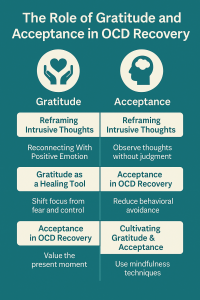
Acceptance and Commitment Therapy (ACT) teaches individuals to accept uncomfortable thoughts and feelings instead of fighting them. Rather than trying to “erase” intrusive thoughts, ACT helps patients observe them mindfully, acknowledge their presence, and choose actions aligned with their values.
How Acceptance Helps Reduce OCD Symptoms
Acceptance softens resistance. When individuals stop judging their thoughts and instead allow them to pass, they break the obsessive cycle. Over time, the brain learns that not engaging with obsessions doesn’t lead to catastrophe—creating space for peace and emotional balance.
Gratitude as a Healing Tool in OCD Recovery
Neuroscience of Gratitude
Gratitude isn’t just a feel-good emotion—it’s a neurochemical rebalancer. Studies show that gratitude activates the prefrontal cortex and anterior cingulate cortex, areas linked to positive emotion and cognitive regulation. This activation decreases the influence of the brain’s fear centers, making anxiety less overwhelming.
Daily Gratitude Practices for OCD Recovery
Gratitude Journaling: Write three things daily that brought calm or clarity, no matter how small.
Mindful Reflection: Pause to acknowledge progress instead of perfection.
Gratitude Walks: Observe the world with curiosity and appreciation, retraining the mind to notice beauty instead of threat.
These small rituals build mental resilience—helping individuals reconnect with a sense of safety and meaning beyond OCD’s distortions.
Integrating Gratitude and Acceptance: A Holistic Framework
Reframing Intrusive Thoughts through Acceptance
Instead of labeling intrusive thoughts as “bad” or “dangerous,” acceptance encourages mindful observation: “This is just a thought—not a fact.” This shift dismantles fear-based reactions.
Reconnecting with Positive Emotion through Gratitude
Gratitude counterbalances OCD’s negativity bias. It redirects attention from control and certainty toward appreciation and wonder—expanding emotional flexibility and fostering long-term stability.
Practical Strategies to Cultivate Gratitude and Acceptance
While understanding gratitude and acceptance is essential, consistent practice is what makes them transformative. These exercises are specifically designed for individuals recovering from OCD to foster emotional balance and mental flexibility.
Mindful Journaling
Mindful journaling is more than a record of thoughts—it’s a way to observe without judgment.
For those with OCD, journaling can help externalize obsessive thoughts and promote self-compassion.
Here’s how to structure it effectively:
Set a daily time — ideally in the evening.
Write down three moments of gratitude from your day. They don’t need to be profound—something as simple as “I appreciated a quiet cup of tea” works.
Add an acceptance reflection — note one intrusive thought or fear you allowed to exist without reacting.
End with a compassionate statement, such as “I did my best today, and that’s enough.”
Over time, this builds emotional resilience and rewires your attention away from fear-driven thinking.
Acceptance-Based Meditation
Acceptance-based meditation aligns closely with mindfulness-based cognitive therapy. The goal isn’t to stop thinking, but to change your relationship with thoughts.
Try this 10-minute daily practice:
Sit comfortably and close your eyes.
Focus on your breath; notice its natural rhythm.
When a thought arises (e.g., “What if I lose control?”), label it gently as “thinking.”
Return your focus to breathing—without judgment or urgency.
This method strengthens your ability to observe intrusive thoughts as passing events, not commands. When done regularly, it complements ERP by teaching emotional neutrality toward distressing thoughts.
Scientific Evidence Supporting Gratitude and Acceptance in Mental Health
Modern research supports what therapists and patients have long observed: gratitude and acceptance improve psychological outcomes by reducing stress, anxiety, and rumination.
A 2017 study in Frontiers in Psychology found that gratitude practices improved emotional regulation and resilience, especially among individuals with chronic anxiety.
Research from Behavior Research and Therapy (2019) showed that combining Acceptance and Commitment Therapy with ERP improved long-term OCD outcomes by enhancing psychological flexibility.
A Harvard Medical School review highlighted that gratitude activates dopamine and serotonin pathways—key neurotransmitters that promote feelings of calm and safety.
Together, these findings demonstrate that integrating gratitude and acceptance enhances both neural recovery and emotional adaptability, essential for sustained OCD healing.
Common Challenges and How to Overcome Them
Even with structured practice, many individuals face internal resistance. Here are the most common obstacles—and how to move through them.
| Challenge | Why It Happens | How to Overcome It |
|---|---|---|
| Emotional Numbness | OCD can desensitize emotional response due to chronic anxiety. | Begin with neutral awareness practices before gratitude journaling. Slowly build emotional range. |
| Perfectionism in Practice | “I must do it right or it won’t work.” | Accept imperfection as part of healing. The act of showing up is progress. |
| Fear of Losing Control | Accepting uncertainty can trigger anxiety. | Start small—practice acceptance in low-stakes situations first. |
| Self-Criticism | Old mental patterns resist change. | Use self-compassion affirmations: “I’m learning, not failing.” |
Remember: healing from OCD is not linear. Progress often feels invisible until, one day, you realize your mind no longer demands absolute control over uncertainty.
Real-Life Stories and Case Insights
Consider “Ava,” a 29-year-old woman diagnosed with contamination OCD. After months of ERP, she still felt emotionally exhausted. Her therapist introduced gratitude journaling alongside acceptance meditation. Within three months, Ava reported reduced anxiety intensity and a renewed sense of connection to everyday life. She began to see her thoughts as “mental weather”—temporary and manageable.
Or “James,” a 35-year-old man struggling with intrusive harm thoughts. By practicing acceptance and using gratitude to reframe his experiences (“I’m grateful my mind warns me because it values safety”), he transformed fear into compassion. This shift helped him engage more confidently in ERP exposures.
These real-life transformations demonstrate how gratitude and acceptance complement traditional therapy, providing the emotional grounding needed for long-term recovery.
The Role of Therapists and Support Systems
While gratitude and acceptance can be self-cultivated, professional guidance amplifies their impact. Therapists trained in ACT, CBT, and ERP can tailor techniques to individual needs—ensuring safety and progress.
Support groups, both online and offline, also foster community accountability. Sharing gratitude reflections within groups creates a collective healing environment, reducing isolation and promoting hope.
👉 For professional OCD resources, explore the International OCD Foundation (iocdf.org)—a trusted organization offering education, research, and therapist directories.
FAQs About Gratitude and Acceptance in OCD Recovery
1. Can gratitude really help with OCD symptoms?
Yes. Gratitude shifts focus from fear and control toward appreciation and connection, activating brain regions that counterbalance anxiety.
2. Is acceptance the same as giving up on recovery?
Not at all. Acceptance means acknowledging what’s happening without resistance. It’s an active stance that empowers change rather than avoidance.
3. How long does it take to notice benefits from these practices?
Most people begin to feel subtle shifts—like reduced emotional reactivity—within 4–6 weeks of consistent practice.
4. Can I practice gratitude even when I feel anxious or intrusive thoughts are strong?
Absolutely. Practicing gratitude during tough moments strengthens emotional endurance and teaches your mind to coexist with discomfort.
5. Should I replace ERP with gratitude and acceptance practices?
No. These methods enhance, not replace, ERP. Think of them as emotional anchors that make ERP more manageable and compassionate.
6. How do I stay consistent with these practices?
Start small—just five minutes a day. Pair gratitude writing with something you already do daily (like morning coffee) to form a habit.
Conclusion: Embracing a Balanced Path to OCD Recovery
Recovery from OCD is more than symptom control—it’s a journey toward emotional freedom. Gratitude and acceptance offer a bridge between fear and peace, helping individuals transform intrusive thoughts into opportunities for self-compassion and growth.
By combining evidence-based therapy with daily gratitude and acceptance practices, individuals can rewire their relationship with anxiety—finding meaning, strength, and balance even in uncertainty. The result isn’t a “perfectly calm” mind, but a resilient one—capable of meeting life as it is, with courage and grace.
🌟 Final Thought
When you learn to say, “Thank you for this moment, even if it’s uncomfortable,” you no longer fight your thoughts—you free yourself from them.


