The Role Of Gratitude And Acceptance In OCD Recovery: A Transformative Approach to Healing


Role Of Gratitude And Acceptance In OCD Recovery: A Transformative Approach to Healing

The Role Of Gratitude And Acceptance In OCD Recovery

Understanding OCD: A Brief Overview

Obsessive-Compulsive Disorder Explained

Role Of Gratitude And Acceptance In OCD Recovery: Obsessive-Compulsive Disorder (OCD) is a mental health condition marked by repetitive, intrusive thoughts (obsessions) and compulsive behaviors performed to reduce anxiety or distress. These thoughts often center around fears of harm, contamination, morality, or perfectionism. While OCD manifests differently for everyone, its defining feature is the cycle of distress and temporary relief—an exhausting loop that limits one’s ability to live freely.

OCD isn’t a character flaw or a lack of willpower; it’s a neurobiological and psychological condition rooted in overactive anxiety circuits and rigid thought patterns. Understanding this foundation is key to approaching recovery with compassion and realism.

The Emotional Toll of OCD

Living with OCD can be emotionally draining. The constant mental battles often give rise to shame, guilt, and hopelessness. Many sufferers feel isolated, misunderstood, or even defined by their condition. Over time, the need for certainty and control can overshadow joy and spontaneity, leading to emotional fatigue.

This emotional burden highlights why healing OCD isn’t just about symptom reduction—it’s also about cultivating emotional flexibility, self-acceptance, and gratitude for one’s inner resilience.


Traditional OCD Recovery Approaches

Cognitive Behavioral Therapy (CBT) and ERP

The cornerstone of OCD treatment is Exposure and Response Prevention (ERP), a form of CBT that helps individuals face their fears without engaging in compulsions. Through gradual exposure, the brain learns that anxiety naturally diminishes over time, reducing the power of obsessions.

ERP is highly effective—but emotionally demanding. It requires consistent practice, courage, and vulnerability. That’s why many therapists now combine ERP with acceptance-based methods, to make the process more compassionate and sustainable.

Limitations of Conventional Treatments

While CBT and medication (such as SSRIs) are effective for many, they don’t always address the emotional and existential layers of OCD recovery. Some people still struggle with feelings of emptiness or fear even after their compulsions lessen. This is where acceptance and gratitude practices become transformative.


The Emerging Role of Acceptance in OCD Recovery

Acceptance and Commitment Therapy (ACT)

Acceptance and Commitment Therapy (ACT) teaches individuals to accept uncomfortable thoughts and feelings instead of fighting them. Rather than trying to “erase” intrusive thoughts, ACT helps patients observe them mindfully, acknowledge their presence, and choose actions aligned with their values.

How Acceptance Helps Reduce OCD Symptoms

Acceptance softens resistance. When individuals stop judging their thoughts and instead allow them to pass, they break the obsessive cycle. Over time, the brain learns that not engaging with obsessions doesn’t lead to catastrophe—creating space for peace and emotional balance.


Gratitude as a Healing Tool in OCD Recovery

Neuroscience of Gratitude

Gratitude isn’t just a feel-good emotion—it’s a neurochemical rebalancer. Studies show that gratitude activates the prefrontal cortex and anterior cingulate cortex, areas linked to positive emotion and cognitive regulation. This activation decreases the influence of the brain’s fear centers, making anxiety less overwhelming.

Daily Gratitude Practices for OCD Recovery

  • Gratitude Journaling: Write three things daily that brought calm or clarity, no matter how small.

  • Mindful Reflection: Pause to acknowledge progress instead of perfection.

  • Gratitude Walks: Observe the world with curiosity and appreciation, retraining the mind to notice beauty instead of threat.

These small rituals build mental resilience—helping individuals reconnect with a sense of safety and meaning beyond OCD’s distortions.


Integrating Gratitude and Acceptance: A Holistic Framework

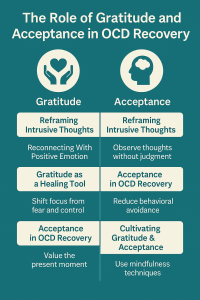
Reframing Intrusive Thoughts through Acceptance

Instead of labeling intrusive thoughts as “bad” or “dangerous,” acceptance encourages mindful observation: “This is just a thought—not a fact.” This shift dismantles fear-based reactions.

Reconnecting with Positive Emotion through Gratitude

Gratitude counterbalances OCD’s negativity bias. It redirects attention from control and certainty toward appreciation and wonder—expanding emotional flexibility and fostering long-term stability.

Practical Strategies to Cultivate Gratitude and Acceptance

While understanding gratitude and acceptance is essential, consistent practice is what makes them transformative. These exercises are specifically designed for individuals recovering from OCD to foster emotional balance and mental flexibility.

Mindful Journaling

Mindful journaling is more than a record of thoughts—it’s a way to observe without judgment.
For those with OCD, journaling can help externalize obsessive thoughts and promote self-compassion.

Here’s how to structure it effectively:

  1. Set a daily time — ideally in the evening.

  2. Write down three moments of gratitude from your day. They don’t need to be profound—something as simple as “I appreciated a quiet cup of tea” works.

  3. Add an acceptance reflection — note one intrusive thought or fear you allowed to exist without reacting.

  4. End with a compassionate statement, such as “I did my best today, and that’s enough.”

Over time, this builds emotional resilience and rewires your attention away from fear-driven thinking.

Acceptance-Based Meditation

Acceptance-based meditation aligns closely with mindfulness-based cognitive therapy. The goal isn’t to stop thinking, but to change your relationship with thoughts.

Try this 10-minute daily practice:

  • Sit comfortably and close your eyes.

  • Focus on your breath; notice its natural rhythm.

  • When a thought arises (e.g., “What if I lose control?”), label it gently as “thinking.”

  • Return your focus to breathing—without judgment or urgency.

This method strengthens your ability to observe intrusive thoughts as passing events, not commands. When done regularly, it complements ERP by teaching emotional neutrality toward distressing thoughts.


Scientific Evidence Supporting Gratitude and Acceptance in Mental Health

Modern research supports what therapists and patients have long observed: gratitude and acceptance improve psychological outcomes by reducing stress, anxiety, and rumination.

  • A 2017 study in Frontiers in Psychology found that gratitude practices improved emotional regulation and resilience, especially among individuals with chronic anxiety.

  • Research from Behavior Research and Therapy (2019) showed that combining Acceptance and Commitment Therapy with ERP improved long-term OCD outcomes by enhancing psychological flexibility.

  • A Harvard Medical School review highlighted that gratitude activates dopamine and serotonin pathways—key neurotransmitters that promote feelings of calm and safety.

Together, these findings demonstrate that integrating gratitude and acceptance enhances both neural recovery and emotional adaptability, essential for sustained OCD healing.


Common Challenges and How to Overcome Them
The Role Of Gratitude And Acceptance In OCD Recovery

Even with structured practice, many individuals face internal resistance. Here are the most common obstacles—and how to move through them.

ChallengeWhy It HappensHow to Overcome It
Emotional NumbnessOCD can desensitize emotional response due to chronic anxiety.Begin with neutral awareness practices before gratitude journaling. Slowly build emotional range.
Perfectionism in Practice“I must do it right or it won’t work.”Accept imperfection as part of healing. The act of showing up is progress.
Fear of Losing ControlAccepting uncertainty can trigger anxiety.Start small—practice acceptance in low-stakes situations first.
Self-CriticismOld mental patterns resist change.Use self-compassion affirmations: “I’m learning, not failing.”

Remember: healing from OCD is not linear. Progress often feels invisible until, one day, you realize your mind no longer demands absolute control over uncertainty.


Real-Life Stories and Case Insights

Consider “Ava,” a 29-year-old woman diagnosed with contamination OCD. After months of ERP, she still felt emotionally exhausted. Her therapist introduced gratitude journaling alongside acceptance meditation. Within three months, Ava reported reduced anxiety intensity and a renewed sense of connection to everyday life. She began to see her thoughts as “mental weather”—temporary and manageable.

Or “James,” a 35-year-old man struggling with intrusive harm thoughts. By practicing acceptance and using gratitude to reframe his experiences (“I’m grateful my mind warns me because it values safety”), he transformed fear into compassion. This shift helped him engage more confidently in ERP exposures.

These real-life transformations demonstrate how gratitude and acceptance complement traditional therapy, providing the emotional grounding needed for long-term recovery.


The Role of Therapists and Support Systems

While gratitude and acceptance can be self-cultivated, professional guidance amplifies their impact. Therapists trained in ACT, CBT, and ERP can tailor techniques to individual needs—ensuring safety and progress.

Support groups, both online and offline, also foster community accountability. Sharing gratitude reflections within groups creates a collective healing environment, reducing isolation and promoting hope.

👉 For professional OCD resources, explore the International OCD Foundation (iocdf.org)—a trusted organization offering education, research, and therapist directories.


FAQs About Gratitude and Acceptance in OCD Recovery

1. Can gratitude really help with OCD symptoms?

Yes. Gratitude shifts focus from fear and control toward appreciation and connection, activating brain regions that counterbalance anxiety.

2. Is acceptance the same as giving up on recovery?

Not at all. Acceptance means acknowledging what’s happening without resistance. It’s an active stance that empowers change rather than avoidance.

3. How long does it take to notice benefits from these practices?

Most people begin to feel subtle shifts—like reduced emotional reactivity—within 4–6 weeks of consistent practice.

4. Can I practice gratitude even when I feel anxious or intrusive thoughts are strong?

Absolutely. Practicing gratitude during tough moments strengthens emotional endurance and teaches your mind to coexist with discomfort.

5. Should I replace ERP with gratitude and acceptance practices?

No. These methods enhance, not replace, ERP. Think of them as emotional anchors that make ERP more manageable and compassionate.

6. How do I stay consistent with these practices?

Start small—just five minutes a day. Pair gratitude writing with something you already do daily (like morning coffee) to form a habit.


Conclusion: Embracing a Balanced Path to OCD Recovery

Recovery from OCD is more than symptom control—it’s a journey toward emotional freedom. Gratitude and acceptance offer a bridge between fear and peace, helping individuals transform intrusive thoughts into opportunities for self-compassion and growth.

By combining evidence-based therapy with daily gratitude and acceptance practices, individuals can rewire their relationship with anxiety—finding meaning, strength, and balance even in uncertainty. The result isn’t a “perfectly calm” mind, but a resilient one—capable of meeting life as it is, with courage and grace.


🌟 Final Thought

When you learn to say, “Thank you for this moment, even if it’s uncomfortable,” you no longer fight your thoughts—you free yourself from them.

Spiritual & Holistic

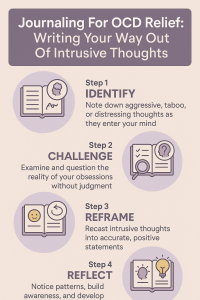
Journaling For OCD Relief: Writing Your Way Out Of Intrusive Thoughts


🧘‍♀️ Journaling For OCD Relief: Writing Your Way Out Of Intrusive Thought   

Journaling For OCD Relief

Understanding OCD and the Power of Expression 

What OCD Really Is: Beyond the Stereotypes

 Obsessive-Compulsive Disorder (OCD) is more than being tidy or particular—it’s a cycle of intrusive thoughts and compulsive behaviors that can feel impossible to escape. People with OCD often experience repetitive, distressing thoughts (“What if I harm someone?”) followed by compulsions to neutralize the anxiety (“I must check repeatedly to make sure I didn’t”).

Why Intrusive Thoughts Feel So Overwhelming

Intrusive thoughts hijack the brain’s fear center, creating an intense emotional reaction. These thoughts stick because the brain mistakenly labels them as dangerous. Suppressing them only strengthens their hold. The key lies in expression and acceptance, not resistance—and journaling provides the perfect outlet for that.

How Writing Helps the Brain Process Anxiety

  Journaling For OCD Relief. When you put words to what’s swirling in your mind, you activate the rational prefrontal cortex. Writing down fears externalizes them, reducing emotional charge and helping you observe thoughts with more objectivity. Journaling becomes a bridge between emotional chaos and cognitive clarity.


The Science Behind Journaling and Mental Health

The Psychology of Externalizing Thoughts

Psychologists describe journaling as “mental decluttering.” It helps your mind offload emotional weight by turning thoughts into tangible language—something the brain can evaluate, contextualize, and ultimately, let go of.

The Role of the Prefrontal Cortex and Emotional Regulation

Neuroscientific studies show that expressive writing increases activity in the prefrontal cortex—the brain’s center for logic and decision-making—while calming the amygdala, which governs fear. This shift reduces anxiety and creates a physiological sense of calm.

Studies Linking Journaling to OCD Symptom Reduction

Research published in Behavior Therapy and Experimental Psychiatry reveals that structured journaling combined with exposure therapy significantly decreases intrusive thought frequency. Writing helps patients reframe cognitive distortions and reduce avoidance behaviors.


How Journaling Can Help You Manage OCD Symptoms

Identifying and Labeling Triggers

Journaling allows you to spot recurring themes or triggers—specific times, situations, or emotions that intensify obsessions or compulsions.

Creating Distance Between You and Your Thoughts

When written on paper, thoughts lose immediacy. Seeing them as words rather than inner voices helps you detach from mental loops and recognize that you are not your thoughts.

Recognizing Compulsion Patterns Through Writing

Regular reflection reveals behavioral cycles: triggers, compulsions, and temporary relief. Awareness is the first step to breaking this loop.

Tracking Progress and Building Awareness

A written record of your journey showcases growth over time. You’ll begin to notice that intrusive thoughts occur less often—or at least, hold less emotional power.


Step-by-Step Guide: Journaling For OCD Relief 

Journaling For OCD Relief: Writing Your Way Out Of Intrusive Thought   
Journaling For OCD Relief

Step 1: Create a Safe Writing Space

Choose a quiet, comfortable environment where you can write freely without fear of judgment or interruption.

Step 2: Choose Your Journal Type (Digital vs. Paper)

Both work—choose what feels most natural. Physical journals can feel grounding, while digital ones offer privacy and convenience.

Step 3: Set an Intention Before You Write

Ask yourself: “Am I writing to release, understand, or reframe?” This guides your focus and helps you stay mindful.

Step 4: Use Prompts to Guide Your Reflection

Instead of free-writing aimlessly, prompts provide direction. Try:

  • “What fear keeps showing up lately?”

  • “How can I respond differently to intrusive thoughts?”

  • “What truth do I know that OCD tries to make me forget?”

Step 5: Don’t Edit or Judge What You Write

Perfectionism fuels OCD. Let your words flow without censoring them. Grammar doesn’t matter—authenticity does.

Step 6: Reflect and Release

After writing, take a moment to breathe. Acknowledge that the act of writing itself is the healing process, not the product.

Step 7: Review Your Entries Periodically

Looking back can reveal patterns of progress and help you celebrate wins, no matter how small.


10 Effective Journal Prompts for OCD Relief

Thought Identification Prompts

  • “What thought am I resisting today, and why?”

  • “If my thought were just a cloud, how fast could it pass?”

Exposure and Acceptance Prompts

  • “What would happen if I allowed uncertainty for five minutes?”

  • “What’s one fear I can face without reacting?”

Gratitude and Mindfulness Prompts

  • “What moment today made me feel calm?”

  • “What am I thankful for that OCD can’t take from me?”

Self-Compassion and Healing Prompts

  • “How can I speak to myself with kindness today?”

  • “What would I tell a friend struggling with this same thought?”


How Often Should You Journal for OCD?

The Power of Daily Consistency

Aim for 10–15 minutes a day. Journaling is most effective when it becomes a consistent ritual rather than an occasional exercise.

How to Avoid Turning Journaling Into a Compulsion

If you feel anxious not writing, or you rewrite entries repeatedly for reassurance, pause and recalibrate. Remember—the goal is expression, not control.


The Connection Between Writing and Mindfulness

How Writing Cultivates Present-Moment Awareness

Writing slows down thought flow, helping you observe rather than react. Each sentence becomes a mindful anchor, grounding you in now.

Mindful Journaling vs. Rumination

Mindful journaling focuses on observing thoughts without analyzing them to death. It’s not about solving problems—it’s about letting go.


Combining Journaling With Therapy for Maximum Relief

How Therapists Use Journals in ERP and CBT

Therapists often integrate journaling into Exposure and Response Prevention (ERP) or Cognitive Behavioral Therapy (CBT) as a tool to track exposures, monitor progress, and identify triggers.

Sharing Insights With Your Mental Health Professional

You don’t have to share every entry—but summarizing insights can help your therapist adjust treatment strategies effectively.


Common Mistakes to Avoid When Journaling for OCD

  • Writing to seek reassurance (“Did I do something wrong?”)

  • Overanalyzing every detail instead of observing feelings

  • Treating journaling as a test of moral worth

  • Skipping reflection after writing

Keep your journal sacred—a place for truth, not perfection.


FAQs About Journaling for OCD Relief

Q1: Can journaling make OCD worse?
If used obsessively, yes. The key is to write to observe, not to fix. Use mindfulness to prevent journaling from becoming another compulsion.

Q2: How long should I write each day?
10–20 minutes daily is ideal. Quality and honesty matter more than length.

Q3: What should I do if writing triggers anxiety?
Pause, breathe, and remind yourself: Feeling discomfort means you’re processing, not failing.

Q4: Is digital journaling as effective as handwriting?
Yes. Choose what feels more comfortable and consistent for you.

Q5: Can journaling replace therapy?
No—but it’s a powerful supplement. Think of it as mental training that enhances professional therapy.

Q6: What type of journal is best for OCD relief?
A private, distraction-free medium—whether paper or app—that feels safe and inviting.


Conclusion: Writing as a Path to Mental Freedom

Journaling for OCD relief isn’t about perfection—it’s about presence. Each word you write weakens the power of intrusive thoughts and strengthens your self-awareness. Over time, writing becomes more than a coping mechanism—it’s a daily act of self-liberation.

Through patience, consistency, and courage, you can truly write your way out of intrusive thoughts—and back into peace.


🧠 External Resource: Learn more about OCD journaling techniques at the International OCD Foundation (IOCDF).

10 Powerful Natural Remedies for Holistic Healing: Reduce OCD Thought Loops Naturally and Safely


Understanding OCD Thought Loops — The Root of the Cycle

Holistic Healing: Natural Remedies To Reduce OCD Thought Loops

Obsessive-Compulsive Disorder (OCD) often manifests through repetitive thought loops—persistent mental cycles that create anxiety, guilt, or self-doubt. These thought patterns can feel impossible to escape, making everyday tasks emotionally exhausting.

Holistic healing offers a different approach. Instead of simply suppressing symptoms, it addresses the root causes—from brain chemistry and emotional regulation to lifestyle and energy balance. This perspective recognizes OCD as not just a mental condition, but a mind-body-spirit imbalance.


What Are OCD Thought Loops and Why They Persist

OCD thought loops are repetitive mental patterns triggered by intrusive thoughts. These loops often involve “what if” scenarios, compulsive analysis, or mental checking. The brain becomes trapped in a feedback loop of anxiety and temporary relief, reinforcing the behavior.

From a holistic viewpoint, thought loops persist due to imbalances in the nervous system and unresolved emotional tension. When cortisol and adrenaline dominate, the brain struggles to differentiate between real and perceived threats.


The Science Behind Obsessive-Compulsive Thought Patterns

Recent studies show that OCD involves dysregulation in the orbitofrontal cortex and basal ganglia, areas responsible for decision-making and habit formation. Low serotonin levels and heightened activity in fear-related pathways also play a role.

Holistic healing complements medical treatment by restoring neurotransmitter balance naturally, supporting nervous system regulation, and promoting mindfulness to retrain thought responses.


The Mind-Body Connection in Holistic Healing

How Emotional Energy Influences Thought Repetition

Emotions act as energetic frequencies that influence how thoughts circulate. When emotions like fear or guilt dominate, thought patterns become denser and repetitive. Practices such as mindful breathing or energy grounding help release trapped energy, breaking the emotional-mental loop that fuels OCD symptoms.

Balancing Neurochemistry Naturally: Serotonin, Dopamine, and Cortisol

Foods rich in tryptophan (like nuts, seeds, and oats) help increase serotonin. Regular exercise boosts dopamine, enhancing motivation and reducing compulsive urges. Additionally, meditation and herbal adaptogens like ashwagandha and rhodiola lower cortisol, calming the overactive stress response that fuels obsessive thoughts.


Top Natural Remedies To Reduce OCD Thought Loops

1. Mindfulness Meditation and Grounding Practices

Mindfulness teaches awareness of thoughts without attachment or judgment. Studies show that consistent mindfulness reduces compulsive thinking by increasing activity in the prefrontal cortex—the part of the brain that governs rational thought.

Grounding techniques, such as focusing on the five senses or deep belly breathing, bring attention back to the present moment, short-circuiting the thought loop before it spirals.


2. Herbal Supplements and Adaptogens for Calm

Nature offers potent remedies for anxiety and intrusive thoughts:

  • Ashwagandha: Stabilizes cortisol and promotes resilience.

  • Rhodiola Rosea: Boosts mental clarity and reduces fatigue.

  • Bacopa Monnieri: Enhances cognitive flexibility and reduces overthinking.

  • Chamomile and Lavender: Gentle herbal relaxants that ease tension and promote rest.

(Always consult a healthcare professional before adding supplements.)


3. Aromatherapy and Essential Oils for Mental Clarity

Aromatherapy engages the limbic system, the brain’s emotional center. Oils like frankincense, lavender, and bergamot promote tranquility and cognitive clarity. Diffusing these oils during meditation enhances their effects and can help anchor the mind during moments of obsessive thinking.


4. Diet and Nutrition: Healing the Gut-Brain Axis

The gut microbiome influences serotonin production and overall brain health. A diet rich in probiotics, fiber, and omega-3 fatty acids supports a balanced gut environment. Avoiding processed sugars, caffeine, and artificial additives can prevent mood fluctuations that trigger obsessive thought cycles.


5. Yoga, Breathwork, and Somatic Movement

Yoga harmonizes body and mind by integrating movement with controlled breathing. Specific poses like Child’s Pose, Forward Fold, and Legs-Up-the-Wall stimulate the parasympathetic nervous system, which slows racing thoughts.

Breathwork practices like box breathing or alternate nostril breathing (Nadi Shodhana) calm neural overactivity and create space between thoughts, reducing the compulsion to engage with them.


6. Journaling, Art, and Creative Outlets as Emotional Release

Creativity transforms mental energy into expression. Journaling helps externalize obsessive thoughts, turning chaos into clarity. Art therapy and music provide similar release, helping individuals move stuck emotions from the subconscious into conscious awareness.


Integrating Holistic Practices with Therapy

Cognitive Behavioral Therapy (CBT) Meets Mindfulness

CBT remains one of the most effective treatments for OCD. When paired with mindfulness, it helps individuals observe rather than engage with intrusive thoughts, reducing reactivity and anxiety.

Exposure and Response Prevention (ERP) in a Holistic Framework

ERP challenges the compulsive cycle by allowing intrusive thoughts without acting on them. Integrating breathwork, grounding, and herbal support during ERP sessions can enhance emotional tolerance and reduce resistance to exposure.


Spiritual Dimensions of Healing OCD Thought Patterns

Holistic healing acknowledges that mental health challenges like OCD are not only biochemical but also energetic and spiritual experiences. This perspective empowers individuals to reconnect with their inner peace and self-awareness.

Energy Healing and Reiki for Mental Balance

Reiki and other forms of energy healing work on the premise that emotional distress and obsessive thoughts are manifestations of energy blockages within the body. When life-force energy (known as chi or prana) becomes stagnant, mental patterns can loop uncontrollably.

Reiki sessions promote relaxation, balance the body’s energy fields, and encourage emotional release. Many individuals report feeling calmer, clearer, and less reactive after regular sessions. Similarly, chakra balancing—particularly working with the third eye (Ajna) and crown (Sahasrara) chakras—can enhance clarity, insight, and trust in intuition, which are often overshadowed by compulsive thought cycles.

The Role of Compassion, Acceptance, and Forgiveness

A crucial element of holistic healing is self-compassion. OCD thought loops often thrive on guilt and self-criticism. Learning to accept one’s thoughts—without judgment—diminishes their emotional grip.

Forgiveness, whether of self or others, frees emotional energy trapped in the mind’s repetitive loops. Practices like loving-kindness meditation (Metta) help soften the heart, teaching the mind that peace is found not in control, but in release.


Creating a Daily Holistic Routine for OCD Recovery

The path to healing requires consistency and structure. Building a daily routine centered around balance helps retrain both the nervous system and the subconscious mind.

Morning Rituals for Calm and Focus

  1. Gratitude journaling – Write three things you’re grateful for upon waking.

  2. Mindful breathing (5–10 minutes) – Practice deep diaphragmatic breathing to reset the mind.

  3. Balanced breakfast – Include omega-3 sources like chia seeds or walnuts to support brain health.

  4. Affirmations – Repeat statements such as “I am grounded, calm, and in control of my thoughts.”

Evening Practices to Quiet the Mind

  1. Digital detox – Avoid screens at least one hour before bed to calm the nervous system.

  2. Aromatherapy bath – Use lavender or chamomile essential oils to unwind.

  3. Gentle yoga or stretching – Release physical tension accumulated during the day.

  4. Journaling – Reflect on the day’s emotions and thoughts to prevent mental buildup overnight.

Establishing such a routine helps the body anticipate periods of calm, reducing overall anxiety and intrusive thought activity.


When to Seek Professional Help — Blending Medical and Holistic Support

While natural remedies offer profound benefits, it’s essential to know when to consult a licensed mental health professional. If obsessive thoughts interfere with daily functioning or cause distress, combining holistic methods with evidence-based treatments like CBT or ERP ensures comprehensive healing.

Holistic care works best when integrated with professional guidance. Collaboration between therapists, psychiatrists, and holistic practitioners allows for an individualized plan that respects both science and spirit.

🌿 Pro Tip: You don’t have to choose between medication and natural methods—many individuals find optimal results through an integrative approach.


FAQs About Holistic Healing for OCD Thought Loops

Holistic Healing: Natural Remedies To Reduce OCD Thought Loops

1. Can holistic healing replace medication for OCD?

Not necessarily. Holistic healing can complement traditional medication, but it’s best to consult a psychiatrist before making any changes. Some individuals successfully reduce symptoms naturally, but this process should always be medically supervised.

2. Which natural remedies are most effective for OCD thought loops?

Mindfulness, adaptogenic herbs like ashwagandha and rhodiola, and grounding exercises tend to be highly effective in reducing anxiety and obsessive thinking. The key is consistency and combining multiple approaches.

3. How long does holistic healing take to show results?

Everyone’s journey is different. Some people notice positive shifts in a few weeks, while others require several months of practice. Patience and routine are essential.

4. Is OCD caused by negative energy or spiritual imbalance?

While OCD has neurological roots, holistic healing recognizes that energetic stagnation and emotional suppression can amplify symptoms. Clearing emotional energy often brings relief alongside conventional treatment.

5. Can diet and nutrition really affect OCD symptoms?

Absolutely. The gut produces about 90% of serotonin, a neurotransmitter linked to OCD. A clean, anti-inflammatory diet rich in probiotics, fiber, and omega-3s can greatly support emotional balance.

6. What’s the best time of day to practice mindfulness for OCD?

Morning and evening are ideal. Starting and ending the day mindfully creates mental stability, helping the brain transition smoothly between focus and rest.


Conclusion: Reclaiming Peace Through Holistic Healing

Holistic Healing: Natural Remedies To Reduce OCD Thought Loops isn’t about “curing” the mind—it’s about reconnecting with inner harmony. By nurturing the body, calming the mind, and aligning with one’s spirit, it becomes possible to transform obsessive patterns into mindful awareness.

Healing OCD is not a linear journey; it’s a cycle of discovery, compassion, and integration. With time, patience, and the right combination of natural and therapeutic support, intrusive thoughts lose their control, and peace becomes the new normal.


🌐 Further Reading and Resources

For additional insights into mindfulness-based approaches for OCD, explore this reputable source:
International OCD Foundation: Mindfulness and Acceptance in OCD Treatment

Spiritual Grounding For OCD: 7 Powerful Ways Faith and Mindfulness Bring Healing and Peace


Spiritual Grounding For OCD: Using Faith And Mindfulness Together 

Spiritual Grounding For OCD

Understanding OCD and Its Spiritual Dimensions

What Is OCD and How It Affects the Mind and Spirit

Obsessive-Compulsive Disorder (OCD) is more than recurring thoughts or rituals—it’s an exhausting cycle of mental compulsion that can hijack peace and clarity. Spiritually, OCD often manifests as a disconnect between one’s faith and internal stability. Individuals struggling with OCD might experience guilt, intrusive doubts about their beliefs, or fear of divine punishment—a condition sometimes referred to as religious scrupulosity.

In spiritual terms, OCD feels like being mentally “ungrounded.” The soul yearns for peace, but the mind loops through endless what-ifs. Recognizing this dual struggle is the first step toward healing—not just emotionally, but spiritually.

Common Triggers and Misconceptions About OCD in Spiritual Contexts

Many believe OCD stems solely from weak faith or lack of discipline. This is false. OCD is a neurological and psychological disorder, not a moral failing. Faith can strengthen resilience, but professional therapy often plays a vital role too. Understanding that spirituality and science complement—rather than contradict—each other empowers individuals to find a holistic path toward balance.


The Concept of Spiritual Grounding Explained

How Grounding Connects Faith, Body, and Mind

Spiritual grounding means aligning your physical presence, thoughts, and spiritual essence with the present moment. It’s a process of rooting your energy in something larger—whether it’s God, the universe, or a sense of inner stillness. For those with OCD, grounding provides a vital anchor against intrusive thought storms.

Spiritual Practices That Promote Mental Stability

Practices like contemplative prayer, nature walks, or mindful scripture reading bring awareness back to the now. These small acts of attention can calm the nervous system, reduce rumination, and foster a stronger connection to one’s faith journey.


Integrating Faith With Mindfulness Practices

Spiritual Grounding For OCD

The Power of Prayer and Meditation in OCD Management

Prayer and meditation offer two sides of the same coin—devotion and observation. Prayer opens communication with the divine; meditation allows you to observe your thoughts without judgment. Together, they build resilience, helping OCD sufferers detach from intrusive thoughts rather than fight them.

Using Religious Rituals as Mindful Anchors

Lighting a candle, reciting a verse, or saying a mantra can serve as mindful rituals. The key is intention. Instead of letting rituals become compulsive, they should nurture awareness, gratitude, and calm.

How Different Faith Traditions Approach Anxiety and Obsession

From Christian centering prayer to Buddhist mindfulness, from Islamic dhikr to Hindu japa meditation—each tradition offers tools for quieting the mind. The shared truth? Stillness invites peace, and faith provides strength to face inner turmoil.


Mindfulness Techniques for Spiritual Healing

Breathing Practices That Enhance Awareness and Calm

Deep, rhythmic breathing activates the parasympathetic nervous system, signaling safety to the brain. Pairing breathwork with prayer (“inhale peace, exhale worry”) turns mindfulness into a sacred act of surrender.

Grounding in the Present Moment Through Sensory Awareness

Notice the coolness of air on your skin, the texture of your seat, or the sound of distant birds. These micro-observations help OCD sufferers stay rooted in the present, away from the mind’s endless questioning.

Combining Mindfulness and Faith in Daily Routines

Start mornings with gratitude prayers, end evenings with mindful reflection. Over time, such rhythms teach the brain to associate faith with calmness rather than compulsion.


Psychological Insights: Why Spiritual Grounding Helps OCD

The Role of Neuroplasticity and Belief Systems

Faith-based mindfulness changes brain patterns. Neuroplasticity—the brain’s ability to rewire—means that consistent grounding can reprogram obsessive thought loops, replacing anxiety with trust.

Reducing Compulsions Through Acceptance and Surrender

True surrender isn’t giving up—it’s giving in to peace. Accepting uncertainty (“I trust in God’s plan”) reduces compulsive checking and rumination, allowing faith to bridge what fear once divided.


Real-Life Examples: Faith-Based Healing from OCD

Case Studies: How Individuals Found Balance Through Prayer and Mindfulness

Many individuals share testimonies of finding calm through prayerful mindfulness. One example: a woman with scrupulosity learned to recite “God understands my heart” whenever intrusive thoughts arose. Over time, this affirmation rewired her response from panic to peace.


Practical Steps to Build a Spiritually Grounded Routine

Morning Rituals for Centeredness and Calm

  • Begin with a short prayer of intention.

  • Practice 5 minutes of deep breathing or meditation.

  • Journal one gratitude item tied to faith.

Nightly Reflection Practices for Release and Gratitude

End the day by acknowledging divine presence and releasing control. A simple phrase like “I release my worries to God” retrains the mind toward trust.


Combining Professional Therapy With Faith-Based Practices

Cognitive Behavioral Therapy (CBT) and Faith Alignment

Therapy doesn’t replace faith—it refines it. CBT helps identify distorted thought patterns, while faith empowers emotional endurance. Together, they form a synergistic path toward lasting recovery.

When to Seek Spiritual vs. Psychological Support

If OCD thoughts lead to guilt, fear, or spiritual confusion, a therapist trained in both psychology and religious sensitivity can help balance both dimensions.


Common Challenges in Spiritual Grounding for OCD

Overcoming Guilt, Religious Scrupulosity, and Fear

Scrupulosity can make faith feel like a burden instead of a blessing. Spiritual grounding teaches that divine love is unconditional—not performance-based.

Finding a Healthy Balance Between Faith and Self-Compassion

Remember: spirituality should heal, not harm. Grounding helps you nurture compassion for yourself as a divine creation, imperfect yet profoundly loved.


Long-Term Benefits of Using Faith and Mindfulness Together

Emotional Resilience, Peace, and Self-Acceptance

Over time, combining faith and mindfulness transforms your internal landscape. You begin to live with peace, not perfection; with acceptance, not avoidance. This is the essence of spiritual grounding.


FAQs About Spiritual Grounding and OCD

Q1. Can spiritual grounding cure OCD completely?
No, but it can significantly reduce anxiety and compulsions when used alongside therapy.

Q2. Is it wrong to use mindfulness in religious practice?
Not at all. Mindfulness enhances faith by deepening awareness of the divine moment.

Q3. How does prayer help with obsessive thoughts?
Prayer shifts focus from fear to faith, reminding the mind that not every thought deserves attention.

Q4. What is religious scrupulosity?
It’s a form of OCD where faith becomes a source of fear or guilt. Grounding restores the balance between devotion and mental peace.

Q5. Can grounding replace medication or therapy?
No. It’s a supportive tool, not a replacement. Always consult a licensed professional.

Q6. What’s the first step to begin spiritual grounding?
Start with simple mindful prayers—breathing deeply and surrendering your thoughts to divine presence.


Conclusion: A Harmonious Path Between Faith and Healing

Spiritual grounding for OCD isn’t about eliminating thoughts—it’s about transforming your relationship with them. When faith and mindfulness unite, they create a sacred bridge between the mind’s chaos and the soul’s calm. Through prayer, presence, and professional guidance, peace isn’t just possible—it’s promised.


🔗 External Link: Learn more about mindfulness and mental health from the National Institute of Mental Health (NIMH).

How To Find Inner Peace When OCD Thoughts Won’t Stop: 15 Proven Mind-Body Strategies


How To Find Inner Peace When OCD Thoughts Won’t Stop: 15 Proven Mind-Body Strategies

How To Find Inner Peace When OCD Thoughts Won’t Stop: 15 Proven Mind-Body Strategies

Understanding OCD: The Science Behind Intrusive Thoughts


How To Find Inner Peace When OCD Thoughts Won’t Stop. Obsessive-Compulsive Disorder (OCD) isn’t just about repetitive behaviors like handwashing or checking locks — it’s also a battle of the mind. Intrusive thoughts can feel like an endless mental loop, replaying worst-case scenarios or irrational fears that seem impossible to silence.

What Happens in the Brain During OCD Episodes

When OCD strikes, the amygdala (the brain’s fear center) becomes hyperactive, flooding the mind with anxiety. Meanwhile, the prefrontal cortex, which governs rational thinking, struggles to keep up. This imbalance triggers obsessive thoughts that demand compulsive “relief” actions — a short-term comfort that fuels the cycle.

The Difference Between OCD Thoughts and Normal Worries

Unlike everyday concerns, OCD thoughts are intrusive, unwanted, and ego-dystonic — meaning they go against your values or intentions. You don’t choose them; they appear suddenly, often causing guilt or fear. The key is to recognize these thoughts as mental noise, not moral truth.

Why Intrusive Thoughts Feel So Real

Your brain can’t easily distinguish between imagination and experience. When a distressing thought surfaces, your body reacts as if it’s real — raising heart rate, releasing cortisol, and heightening vigilance. Over time, this creates a pattern where fear itself becomes the trigger.


The Connection Between Anxiety, Mindfulness, and Peace

How Anxiety Feeds Obsessive Thinking

Anxiety acts as the fuel that keeps OCD thoughts alive. Each time you resist a thought or try to “fix” it, the brain learns that the thought is dangerous — reinforcing the obsession. The antidote isn’t control but acceptance and non-reaction.

Mindfulness as a Gateway to Inner Calm

Mindfulness teaches you to observe thoughts without attachment or judgment. By shifting attention from content (“What if I do something terrible?”) to process (“I’m noticing fear”), you rewire your response to uncertainty.

The Science of Acceptance and Cognitive Flexibility

Studies in cognitive behavioral therapy (CBT) and Acceptance and Commitment Therapy (ACT) show that cognitive flexibility — the ability to experience thoughts without reacting — dramatically reduces OCD intensity. Peace begins when you stop fighting your mind.


15 Practical Steps to Find Inner Peace When OCD Thoughts Won’t Stop

How To Find Inner Peace When OCD Thoughts Won’t Stop: 15 Proven Mind-Body Strategies

Step 1: Label Thoughts Without Judgment

Instead of saying “I’m having a scary thought,” say “I’m noticing a thought labeled as scary.” This simple linguistic shift creates distance between you and the obsession.

Step 2: Ground Yourself Using the 5-4-3-2-1 Technique

Identify 5 things you see, 4 you can touch, 3 you hear, 2 you smell, and 1 you taste. Grounding pulls your focus back into the present moment — where OCD has no power.

Step 3: Practice “Response Prevention” to Regain Control

Exposure and Response Prevention (ERP) therapy teaches that resisting compulsions weakens OCD’s grip. When you don’t perform the ritual, anxiety rises temporarily but decreases over time.

Step 4: Breathe With Intention — The Box Breathing Method

Breathing is one of the most direct ways to communicate safety to your nervous system. The Box Breathing Method—inhaling for 4 seconds, holding for 4, exhaling for 4, and holding again for 4—slows your heart rate and regulates stress hormones. Practicing this for even two minutes can anchor you back into the present moment and reduce the intensity of obsessive thoughts.

Step 5: Reframe “What If” Thinking into “Even If” Thinking

OCD thrives on “what if” fears. Instead of resisting them, reframe them.
For example:

  • “What if I fail?” → “Even if I fail, I’ll learn something valuable.”
    This subtle shift turns fear into acceptance, transforming anxiety into resilience.

Step 6: Use Guided Meditations for OCD Relief

Listening to guided meditations specifically designed for OCD can retrain your brain to tolerate uncertainty and discomfort. Platforms like Insight Timer or Headspace feature therapists who guide users through relaxation and cognitive diffusion techniques.

Step 7: Reduce Digital Overstimulation for Mental Clarity

Constant digital exposure—from news alerts to social media—keeps the mind in a state of hyper-vigilance, a breeding ground for OCD triggers. Designate “tech-free zones” throughout your day to allow your brain to decompress.

Step 8: Exercise and Nutrition for a Balanced Mind

Movement helps metabolize stress hormones, while nutrition fuels neurotransmitters that regulate mood. Regular aerobic exercise (like walking, running, or yoga) boosts serotonin and dopamine, the same brain chemicals targeted by OCD medications. Pair this with an anti-inflammatory diet—rich in omega-3s, greens, and lean protein—to stabilize emotional balance.

Step 9: Journal Your Thoughts to Release Control

Writing down intrusive thoughts helps externalize them, turning abstract fears into tangible words. This technique, often used in cognitive-behavioral therapy, lets you observe your thinking patterns and realize that thoughts don’t define you—they’re merely mental events passing through.

Step 10: Seek Professional Help (ERP & CBT Explained)

Two of the most effective therapies for OCD are:

  • Exposure and Response Prevention (ERP): Teaches you to face fears without performing compulsions.

  • Cognitive Behavioral Therapy (CBT): Helps reframe distorted thought patterns.
    Both methods are scientifically proven to reduce obsessional distress and restore peace over time.

Step 11: Set Compassionate Boundaries With Yourself

Inner peace starts with self-kindness. Instead of berating yourself for intrusive thoughts, treat your mind with compassion. Acknowledge that these thoughts arise from anxiety, not character flaws. Replace harsh self-criticism with nurturing affirmations like, “I’m learning to coexist with uncertainty.”

Step 12: Create a “Peace Ritual” Before Bedtime

Evenings can be challenging for those with OCD, as quiet moments invite overthinking. Establish a nightly “peace ritual” — light stretching, journaling, or listening to ambient music — to signal your body that it’s safe to rest. Over time, this consistent habit strengthens your emotional resilience.

Step 13: Use Affirmations to Replace Mental Loops

Affirmations redirect your focus away from intrusive thoughts and toward grounding truths. Repeat mantras such as:

  • “My thoughts don’t define me.”

  • “Peace is available to me now.”
    Over time, this practice reprograms your subconscious mind to respond calmly, not reactively.

Step 14: Practice Gratitude to Rewire Your Focus

Gratitude reshapes brain circuitry by emphasizing abundance over fear. Write down three things you’re grateful for each day, even if they’re small. This daily discipline weakens the brain’s obsession with negativity and fosters a lasting sense of peace.

Step 15: Accept Uncertainty as a Path to Freedom

At its core, OCD is a disorder of intolerance to uncertainty. Paradoxically, true peace emerges when you embrace not knowing. The more you practice accepting unpredictability, the less control OCD has over you. This surrender is not weakness—it’s liberation.


The Role of Spirituality in Healing OCD Thoughts

Finding Faith Without Fear: How Spiritual Practices Soothe OCD

For many, spirituality offers deep comfort—but OCD can sometimes distort religious or moral beliefs, creating scrupulosity. The key is to reconnect with faith from a place of love, not fear. Gentle practices such as prayer, chanting, or mindful contemplation can help you access inner peace without reinforcing compulsions.

The Power of Meditation and Stillness

Meditation trains the mind to observe thoughts without resistance. Even five minutes of silent awareness can quiet the mental “background noise.” Techniques like Loving-Kindness Meditation nurture compassion, helping you heal the guilt and shame often tied to OCD.


Lifestyle Adjustments for Long-Term Peace

Sleep, Diet, and Routine Optimization

Sleep deprivation magnifies anxiety and intrusive thoughts. Strive for 7–9 hours of quality rest nightly, maintain a consistent schedule, and minimize caffeine after midday. Combine this with balanced nutrition to support brain health and regulate emotional stability.

Building Support Systems and Accountability Circles

Isolation fuels OCD. Join peer support groups, online communities, or therapy groups where others understand your experience. Sharing your journey reminds you that healing is possible and that you’re never alone.

Tracking Progress With Mindfulness Apps

Modern tools like Calm, MindShift, or NOCD can help you track symptoms, manage triggers, and stay consistent with ERP or mindfulness practices. Digital accountability fosters real-world transformation.


When to Seek Professional Help

Therapy Options: ERP, CBT, ACT, and Mindfulness-Based Approaches

If intrusive thoughts severely impact daily life, working with a licensed mental health professional is essential. Acceptance and Commitment Therapy (ACT) and Mindfulness-Based Cognitive Therapy (MBCT) blend mindfulness with exposure techniques, helping patients achieve peace without suppression.

Medication and Its Role in OCD Management

In some cases, SSRIs (Selective Serotonin Reuptake Inhibitors) can complement therapy by balancing brain chemistry. Medication doesn’t erase OCD but can make coping strategies more effective by lowering anxiety levels.


FAQs About OCD and Inner Peace

Q1: What causes OCD thoughts to feel uncontrollable?
OCD thoughts feel uncontrollable because they originate from hyperactive brain circuits involving fear and error detection. However, with therapy and mindfulness, you can retrain these circuits.

Q2: Can meditation make OCD worse?
If done without guidance, yes—it can sometimes intensify awareness of intrusive thoughts. Starting with guided meditations designed for OCD is recommended.

Q3: How do I stop intrusive thoughts naturally?
Natural methods include mindfulness, grounding exercises, breathing techniques, and journaling. The key is non-resistance—allowing thoughts to come and go.

Q4: Is it possible to fully overcome OCD?
While OCD is often chronic, many people achieve complete symptom remission through therapy, medication, and lifestyle changes.

Q5: Can lifestyle changes really reduce OCD symptoms?
Absolutely. Regular exercise, proper sleep, balanced nutrition, and stress reduction directly influence neurotransmitter balance, lessening OCD’s intensity.

Q6: What is the best daily habit for inner peace?
Consistency in mindfulness practice—just 10 minutes a day—has the most lasting effect on cultivating calmness and emotional stability.


Conclusion: Reclaiming Serenity Amid Mental Chaos

Finding peace when OCD thoughts won’t stop isn’t about silencing your mind—it’s about changing your relationship with it. By accepting uncertainty, nurturing mindfulness, and practicing compassion, you can create space between thought and reaction. Over time, this space becomes your sanctuary—a calm, resilient core untouched by mental noise.

Remember: inner peace isn’t the absence of thoughts. It’s the ability to observe them without losing yourself.

For further reading and professional guidance, visit the International OCD Foundation — a trusted resource for understanding and managing OCD.

You cannot copy content of this page