Table of Contents
ToggleCognitive & Behavioral Approaches Overview: Powerful Frameworks for Understanding Human Thinking and Behavior
Introduction to Cognitive & Behavioral Approaches overview
The world of psychology has grown through many theories, but few have shaped modern mental health and learning as powerfully as the Cognitive & Behavioral Approaches overview. These frameworks help us understand why people think the way they think, why they behave the way they behave, and how thoughts and actions can be changed to improve well-being.
Cognitive psychology focuses on internal mental processes—like thinking patterns, beliefs, attention, and perception. Behavioral psychology focuses on observable actions, reinforcement, and learning from the environment. When combined, these approaches create a practical, evidence-based model used every day in psychotherapy, education, parenting, corporate training, and self-improvement.
This article will break down these two essential branches of psychology into simple, clear explanations tailored for a 7th-grade reading level—while still providing expert depth, research-based insight, and real-world applications.
Historical Foundations of Cognitive and Behavioral Psychology
Rise of Behaviorism
Behaviorism became popular in the early 1900s through scientists like John B. Watson and B.F. Skinner, who believed psychology should only study what can be seen: behavior.
They argued that thoughts cannot be measured, but actions can. This focus led to major discoveries about learning, habit formation, and reinforcement.
Emergence of the Cognitive Revolution
By the 1950s, behaviorism alone couldn’t explain complex human learning. A new wave of researchers introduced the cognitive revolution, studying how the mind works like an information-processing machine. This new approach explored memory, attention, decision-making, and interpretation of experiences.
Core Principles of Behavioral Approaches
Classical Conditioning Mechanisms
This model shows how people learn through association. For example, if a child hears thunder after lightning repeatedly, they may start feeling scared whenever they see lightning.
Operant Conditioning: Rewards, Punishment, and Reinforcement
Skinner’s theory demonstrated that actions followed by rewards are repeated, while actions followed by punishment tend to stop.
This remains widely used in classrooms, therapy, and parenting.
Social Learning and Observational Behaviors
Albert Bandura introduced the idea that people learn not only from direct experience but also by watching others. This explains why children often mimic adults.
Core Principles of Cognitive Approaches
Cognitive Schemas and Information Processing
Cognitive psychologists say the mind uses schemas—mental frameworks that help us organize and interpret information.
Automatic Thoughts and Internal Dialogue
Our minds generate quick, automatic thoughts that influence our feelings and actions—even when we don’t notice them.
Mental Filtering and Interpretation Biases
People sometimes focus only on negative details or interpret events incorrectly, which can fuel anxiety or sadness.
How Cognitive and Behavioral Models Integrate (CBT)
How Thoughts Shape Emotions and Behavior
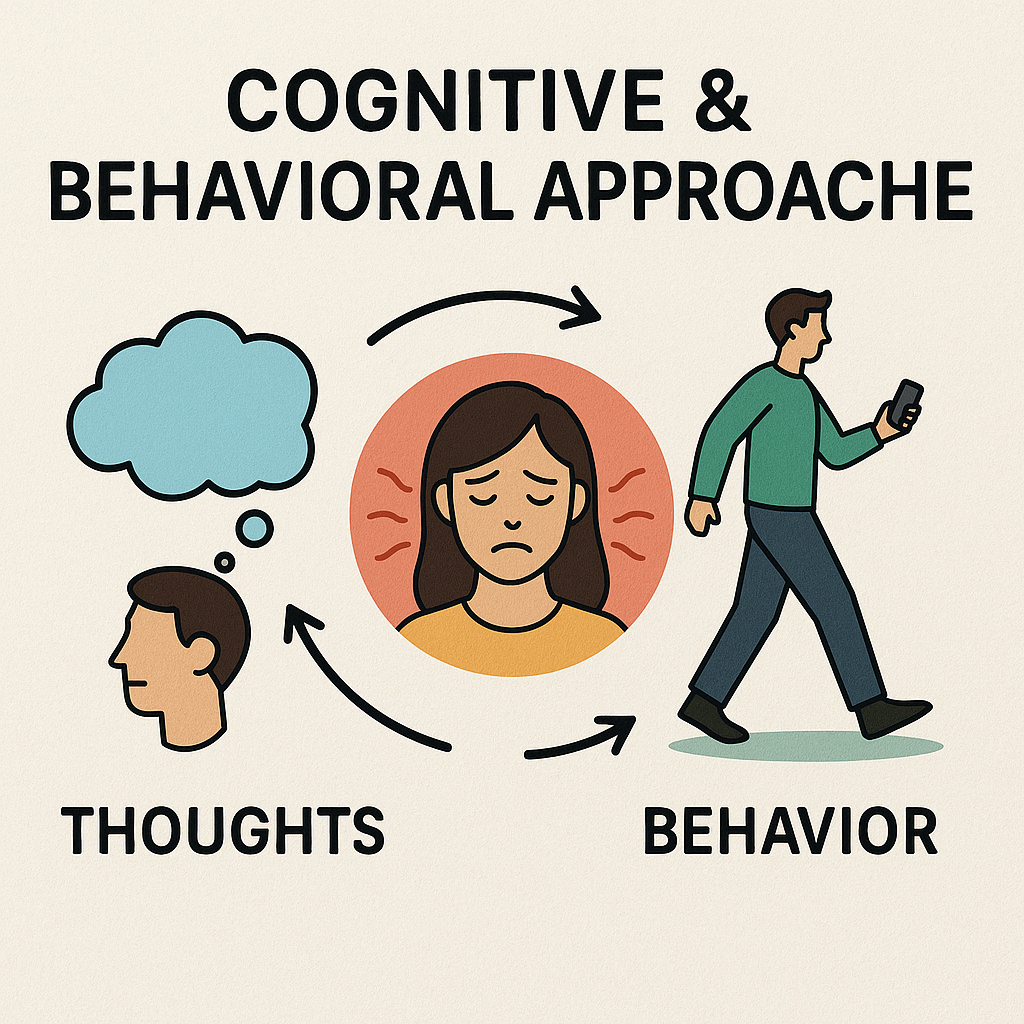
Cognitive Behavioral Therapy (CBT) shows that your thoughts affect your emotions, which then affect your actions.
The CBT Triangle Explained
The CBT triangle connects thoughts, feelings, and behaviors. Changing one part helps improve the others.
Techniques for Cognitive Reframing
CBT helps people challenge unhelpful thoughts and replace them with more realistic ones.