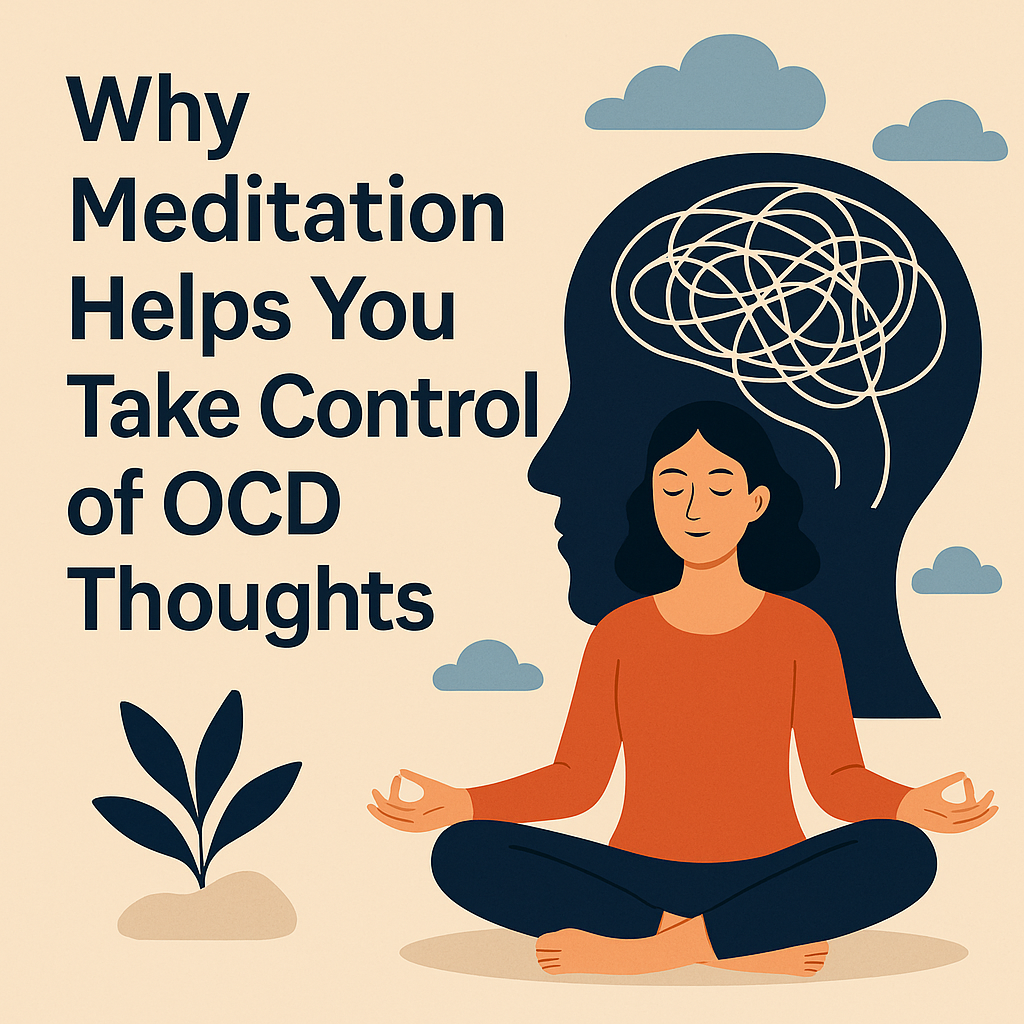

🧘♀️ Why Meditation Helps You Take Control of OCD Thoughts
Understanding OCD: The Battle with Unwanted Thoughts

Obsessive-Compulsive Disorder (OCD) is more than just perfectionism or neatness — it’s a mental health condition driven by unwanted, intrusive thoughts and repetitive behaviors. People with OCD often feel trapped in a loop: a distressing thought appears, anxiety rises, and they perform rituals to neutralize that fear. Unfortunately, these rituals provide only temporary relief, reinforcing the cycle.
OCD affects nearly 2–3% of the population worldwide, cutting across all ages and backgrounds. These obsessive thoughts can range from contamination fears to worries about harm, morality, or order. What makes them so tormenting is their persistence — they come uninvited, often at the worst times, and feel impossible to control.
How OCD Affects the Brain and Mind
The OCD brain is uniquely wired. Neuroimaging studies show hyperactivity in the orbitofrontal cortex, anterior cingulate cortex, and caudate nucleus — regions involved in decision-making, emotion regulation, and error detection. This overactivation makes it difficult for sufferers to distinguish between real and imagined threats.
Furthermore, serotonin imbalances can heighten anxiety responses, making it feel like every intrusive thought demands urgent action. The result is a “false alarm” system — the brain signals danger when none exists.
The Role of Compulsions and Anxiety Loops
Compulsions, whether physical (washing, checking) or mental (counting, praying), act as temporary coping mechanisms. However, each act reinforces the obsessive loop. Over time, the brain learns that rituals equal relief — strengthening the obsessive-compulsive cycle.
Breaking this loop requires awareness, acceptance, and retraining the brain’s response — which is where meditation becomes a powerful ally.
Meditation: A Science-Backed Path to Mental Calm
Meditation isn’t about suppressing thoughts — it’s about observing them without judgment. By cultivating mindfulness, individuals can step back from intrusive thoughts and see them as temporary mental events, not commands that demand action.
Scientific research supports this: regular meditation lowers cortisol levels, balances serotonin, and activates the prefrontal cortex — the brain’s rational center. This shift allows for calmer, more intentional responses instead of knee-jerk reactions to intrusive thoughts.
Types of Meditation That Benefit OCD Sufferers
Mindfulness Meditation – Encourages awareness of the present moment, helping individuals recognize intrusive thoughts without reacting.
Breath Awareness Meditation – Focuses on rhythmic breathing to ground the mind during anxiety spikes.
Body Scan Meditation – Helps release tension stored in the body, reducing physical anxiety symptoms.
Loving-Kindness Meditation (Metta) – Promotes self-compassion, reducing guilt and shame associated with OCD.
Mantra Meditation – Replaces obsessive loops with calm, repetitive affirmations or phrases.
Mindfulness vs. Traditional Meditation
While traditional meditation often emphasizes focus or transcendence, mindfulness meditation emphasizes awareness and acceptance. For OCD sufferers, this approach is particularly effective — it teaches that thoughts are just thoughts, not truths or threats. Over time, mindfulness reduces the intensity and frequency of intrusive thoughts by changing the relationship with them.
How Meditation Helps You Take Control of OCD Thoughts
Meditation empowers OCD sufferers to take back control — not by eliminating intrusive thoughts, but by changing how they respond to them.
Reducing Intrusive Thoughts Through Present-Moment Awareness
Meditation anchors the mind in the “now.” When practiced consistently, mindfulness reduces rumination by pulling attention away from what-ifs and imagined fears. Each breath becomes a reminder that control doesn’t come from suppressing thoughts — but from letting them pass without engagement.
Rewiring the Brain: Neuroplasticity and OCD Relief
Research shows meditation enhances neuroplasticity, the brain’s ability to form new neural pathways. Over time, this rewiring strengthens areas related to calm decision-making and weakens anxiety circuits. Essentially, meditation trains your brain to remain calm even when OCD triggers appear.
Managing Anxiety Triggers and Emotional Responses
Meditation lowers the body’s stress response, reducing cortisol and adrenaline. By practicing regularly, you become more aware of early signs of anxiety, allowing you to respond with mindfulness instead of compulsion. This newfound self-awareness builds emotional resilience.
Scientific Studies Supporting Meditation for OCD
A 2018 study published in Frontiers in Psychology found that mindfulness-based therapy significantly reduced OCD symptoms in participants who practiced daily meditation. Another 2021 review in Clinical Psychology Review confirmed that Mindfulness-Based Cognitive Therapy (MBCT) and Acceptance and Commitment Therapy (ACT) help reduce obsessive thinking and improve emotional regulation.
These findings show that meditation is more than a spiritual practice — it’s a neuroscience-backed tool for mental healing.
Real-Life Case Studies and Success Stories
Consider Jessica, a 29-year-old teacher diagnosed with OCD. Through six months of guided mindfulness meditation, she learned to observe intrusive thoughts without panic. Her compulsion frequency dropped by 60%. Similarly, Mark, a student, used breath meditation to manage test anxiety, breaking the link between stress and compulsions.
Step-by-Step Guide: Starting Meditation for OCD
Find a Quiet Space: Choose a distraction-free environment.
Set a Timer: Begin with 5–10 minutes daily.
Focus on Breathing: Notice each inhale and exhale.
Observe Thoughts: When intrusive thoughts arise, label them gently (“thinking”) and return to the breath.
End with Gratitude: Acknowledge your effort, even if your mind wandered.
How to Create a Meditation Routine That Works
Consistency is key: Even 10 minutes daily creates long-term change.
Pair it with therapy: Meditation complements Exposure and Response Prevention (ERP) therapy effectively.
Track progress: Journaling helps measure emotional improvements.
Use gentle guidance: Apps like Headspace or Insight Timer provide structured sessions.
Tools and Apps to Support Meditation Practice
| App Name | Key Feature | Best For |
|---|---|---|
| Headspace | Guided mindfulness for beginners | Anxiety and intrusive thoughts |
| Calm | Sleep and relaxation programs | Evening meditation |
| Insight Timer | Thousands of free meditations | Long-term consistency |
| Waking Up | Deep mindfulness theory + practice | Advanced users |
Common Challenges and How to Overcome Them
Wandering Thoughts: Accept them and return gently to your breath.
Restlessness: Try shorter sessions until focus improves.
Emotional Discomfort: Meditation can bring up buried emotions — breathe through them and seek support if needed.
Lack of Motivation: Remember, progress is gradual but permanent.
When to Seek Professional Help
Meditation is powerful, but not a standalone cure. If OCD symptoms cause significant distress or interfere with daily life, consult a therapist. Combining Cognitive Behavioral Therapy (CBT), Exposure and Response Prevention (ERP), and meditation yields the best results.
(See: National Institute of Mental Health – OCD Treatment)
FAQs about Meditation and OCD
Q1: Can meditation cure OCD completely?
No, meditation isn’t a cure, but it’s a highly effective management tool that reduces symptoms and promotes emotional control.
Q2: How long before I notice results?
With consistent daily practice, many people notice improvements in 4–8 weeks.
Q3: Should I meditate during OCD flare-ups?
Yes — even short sessions can calm anxiety spikes and reduce intrusive thought intensity.
Q4: Can meditation worsen OCD?
Rarely. Some people may initially feel more aware of their thoughts, but this awareness is part of the healing process.
Q5: Is guided meditation better for OCD beginners?
Absolutely. Guided meditations provide structure and reassurance, making it easier to stay consistent.
Q6: What’s the best time to meditate for OCD relief?
Morning or bedtime are ideal — when the mind is naturally quieter and more receptive.
Conclusion: Regaining Control Through Stillness
Meditation gives you the one thing OCD tries to take away — control. Not by fighting thoughts, but by observing them calmly. Each mindful breath weakens OCD’s grip, replacing fear with understanding and chaos with peace.
Remember: freedom from OCD isn’t about erasing thoughts — it’s about changing your relationship with them. Through consistent meditation, you reclaim your mental space, one breath at a time.


