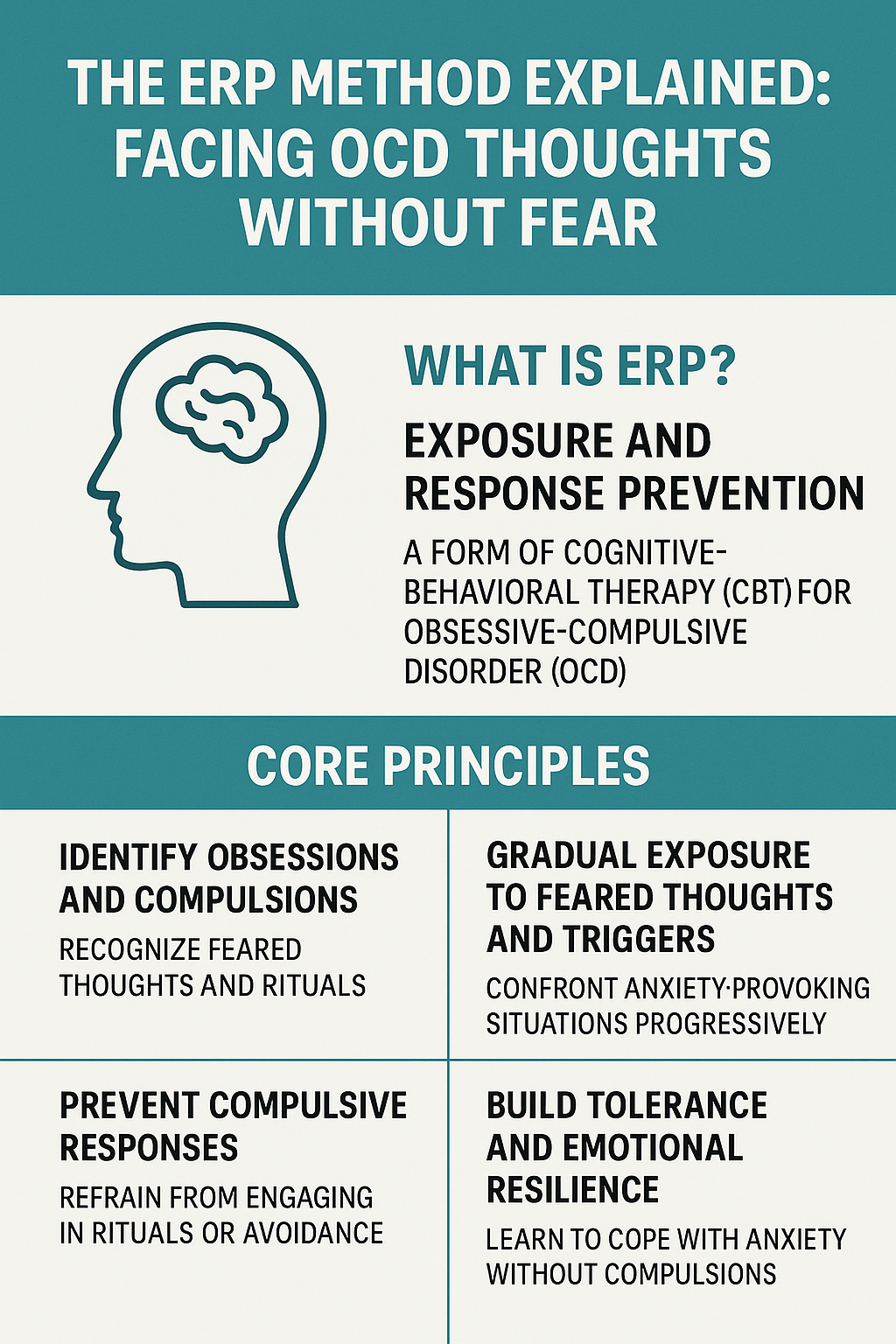
The ERP Method Explained: Facing OCD Thoughts Without Fear
Introduction to the ERP Method and Its Role in Treating OCD

Living with obsessive-compulsive disorder (OCD) often feels like being trapped in a loop of unwanted thoughts and rituals. These intrusive thoughts can create unbearable anxiety, leading sufferers to perform compulsions as a way to feel “safe.” But what if the very behaviors meant to bring relief are the ones feeding the cycle?
That’s where ERP (Exposure and Response Prevention) therapy comes in — a scientifically proven approach that helps people face OCD thoughts head-on, without fear or avoidance. By gradually exposing individuals to their fears while preventing their usual compulsive responses, ERP helps retrain the brain to react differently to anxiety.
ERP is widely recognized as the gold standard treatment for OCD, recommended by leading mental health organizations like the International OCD Foundation (IOCDF) and the American Psychological Association (APA). It offers real hope for those who have tried everything else and still feel trapped by their own thoughts.
Understanding Obsessive-Compulsive Disorder (OCD)
OCD is a mental health disorder characterized by two main components — obsessions and compulsions.
Obsessions are intrusive, unwanted thoughts, images, or urges that trigger distress or anxiety.
Compulsions are repetitive behaviors or mental rituals performed to neutralize or “undo” that distress.
For example, a person with contamination OCD may fear germs and wash their hands dozens of times a day. Another with “harm OCD” might repeatedly check if they’ve accidentally hurt someone, even when they haven’t.
The pattern is the same: fear → obsession → compulsion → temporary relief → stronger fear. ERP breaks this loop.
The Link Between Fear, Anxiety, and OCD
Fear plays a central role in OCD. It’s not just fear of an outcome — like getting sick or losing control — but fear of the thoughts themselves. People with OCD often say, “I know this doesn’t make sense, but it feels real.”
That emotional “realness” comes from how the brain misinterprets intrusive thoughts as threats. ERP helps correct this misinterpretation by teaching the brain that thoughts, no matter how disturbing, are just thoughts — not commands or truths.
What Is ERP Therapy?
The Meaning of “Exposure and Response Prevention”
ERP stands for Exposure and Response Prevention, a type of Cognitive-Behavioral Therapy (CBT) specifically designed for OCD. It involves two key components:
Exposure: Facing feared situations, thoughts, or triggers in a controlled way.
Response Prevention: Resisting the urge to perform compulsions or safety behaviors.
Together, these steps teach the brain that anxiety naturally fades over time, even without rituals or avoidance.
The Science Behind ERP and Cognitive-Behavioral Therapy (CBT)
ERP works by leveraging neuroplasticity, the brain’s ability to form new connections. Through repeated exposure, the brain learns that the feared outcome never occurs — or isn’t as catastrophic as it seems. Over time, the anxiety response weakens, and the person gains confidence in their ability to tolerate distress.
Research has consistently shown ERP’s effectiveness. Studies reveal that 60–80% of OCD patients experience significant improvement after completing ERP therapy, making it one of the most evidence-based treatments available.
Common Myths About ERP Therapy
There are several misconceptions about ERP:
Myth 1: ERP is about “flooding” patients with fear.
Truth: It’s gradual and collaborative, never forced.Myth 2: ERP eliminates anxiety completely.
Truth: It teaches you to live with uncertainty, not eradicate it.Myth 3: ERP is only for severe OCD.
Truth: It can help mild to severe cases and even subclinical anxiety.
How ERP Works: The Core Principles Explained
ERP typically unfolds in structured stages, designed to gently guide patients toward resilience.
Step 1: Identifying Obsessions and Compulsions
The therapist helps the individual list their intrusive thoughts and corresponding compulsions, rating each on a fear hierarchy — from mildly distressing to extremely anxiety-provoking.
Step 2: Gradual Exposure to Feared Thoughts and Triggers
Starting with lower-anxiety triggers, the individual deliberately confronts them while resisting compulsions. For example, someone afraid of contamination might touch a doorknob and avoid washing their hands for a set period.
Step 3: Preventing Compulsive Responses
The most powerful part of ERP is response prevention — learning to sit with anxiety without performing rituals. Over time, the brain realizes that nothing bad happens, and the urge to perform compulsions diminishes.
Step 4: Building Tolerance and Emotional Resilience
Through repeated practice, ERP builds distress tolerance — the ability to feel uncomfortable without reacting impulsively. This skill extends beyond OCD, improving overall emotional stability..
Real-Life Examples of ERP in Action
Understanding how ERP works in real-world scenarios can make the process less intimidating and more relatable. Here are some common examples of ERP exercises tailored to different OCD themes:
Example 1: Contamination OCD
A person with contamination OCD might fear that touching public surfaces will make them or others sick.
ERP Exercise: The therapist may guide them to touch a doorknob or money without washing their hands immediately afterward. Over time, they learn that nothing catastrophic happens — their anxiety peaks, then fades naturally.
Example 2: Intrusive Thoughts OCD
Someone plagued by disturbing thoughts (like “What if I hurt someone?”) may try to suppress or neutralize these thoughts with mental rituals.
ERP Exercise: Instead of avoiding the thought, the person intentionally brings it to mind and refrains from performing mental “undoing” rituals. This helps the brain learn that thoughts are harmless and don’t require control.
Example 3: Checking OCD
A person constantly checks if the stove is off or the door is locked.
ERP Exercise: They may check once, take a photo for reassurance, and resist re-checking. Over sessions, they gradually stop the safety behavior entirely, discovering that uncertainty can be tolerated.
These examples highlight that ERP isn’t about eliminating thoughts but changing your relationship with them. By learning that anxiety and discomfort can be endured, the power of OCD diminishes.
The Psychological Mechanisms Behind ERP’s Success
ERP is powerful not because it’s magical, but because it rewires how the brain processes fear and uncertainty. Here’s how:
How Habituation Reduces Anxiety Over Time
When we avoid something that scares us, our brain never learns that it’s safe. ERP breaks this avoidance cycle. By repeatedly facing the fear, habituation occurs — the anxiety naturally decreases after repeated exposure, just like how cold water feels warmer after a few moments.
The Role of Neuroplasticity in ERP Progress
The brain is constantly learning. Through ERP, new neural pathways form that associate previously feared situations with safety rather than danger. Over time, the “OCD alarm system” quiets down. This is neuroplasticity at work — your brain literally reshaping itself to support recovery.
Benefits of ERP Therapy for OCD Sufferers
ERP offers more than just symptom relief — it creates lasting transformation. Here’s how it changes lives:
Long-Term Anxiety Reduction
Instead of offering short-term comfort (like compulsions do), ERP trains the brain for long-term calm. Anxiety becomes a signal to lean into discomfort, not run away from it.
Improved Quality of Life and Self-Confidence
As individuals face fears and survive without rituals, their confidence grows. They regain control over their daily lives — relationships improve, productivity increases, and self-worth flourishes.
Evidence-Based and Enduring Results
Unlike many treatments that lose effectiveness, ERP’s impact tends to endure over time. Studies consistently show that individuals who complete ERP maintain their progress for years afterward.
Challenges and Common Fears in ERP Therapy
While ERP is transformative, it’s not always easy. Understanding potential challenges helps prepare for success.
Facing Your Worst Fears Without Compulsion
ERP asks you to face the very situations that cause distress — without performing rituals. This can initially increase anxiety. But therapists ensure exposures are gradual and manageable, building strength step by step.
Dealing with Resistance and Setbacks
It’s common to feel frustrated or scared during ERP. Progress isn’t linear — some days are harder than others. The key is self-compassion and persistence. Every moment of resistance faced without ritual is a victory.
Remember, ERP isn’t about perfection — it’s about progress.
ERP vs. Other OCD Treatments
To appreciate ERP’s uniqueness, let’s see how it compares to other common approaches.
| Treatment Type | Approach | Effectiveness for OCD |
|---|---|---|
| ERP Therapy | Gradual exposure to feared thoughts while preventing compulsions | High (60–80% success rate) |
| Medication (SSRIs) | Reduces anxiety by altering serotonin levels | Moderate, often used with ERP |
| Talk Therapy | Discusses emotions without behavioral change | Low for OCD |
| Psychoanalysis | Explores unconscious motives | Ineffective for OCD symptoms |
ERP stands out because it targets the behavioral patterns maintaining OCD, not just the thoughts or feelings.
Tips for Getting Started with ERP Therapy
ERP is most effective when approached intentionally. Here are some practical steps to begin your journey:
Working with a Certified ERP Therapist
Look for a therapist trained in ERP or CBT. Many are certified by the International OCD Foundation (IOCDF) or similar organizations. A good therapist will create a personalized fear hierarchy and guide you with empathy and structure.
Setting Realistic Goals and Expectations
ERP takes time — progress is often gradual. Start small, celebrate wins, and accept that temporary discomfort leads to lasting peace.
Tracking Progress and Managing Relapse
Journaling helps track triggers, exposures, and emotional responses. If old fears resurface, returning to ERP techniques quickly prevents relapse.
Self-Help ERP Techniques You Can Practice Safely
If professional therapy isn’t immediately accessible, these self-help strategies can serve as a foundation.
Imaginal Exposure Exercises
Write detailed scripts about your feared thoughts or situations. Read them daily until the fear response weakens. This mental exposure mimics real-life ERP and strengthens your tolerance to anxiety.
Journaling and Mindfulness for OCD Management
Mindfulness complements ERP by teaching nonjudgmental awareness of thoughts. Instead of labeling thoughts as “good” or “bad,” mindfulness encourages observing them as passing mental events — not truths demanding action.
The Importance of Professional Guidance
ERP can be emotionally demanding, and having the right support system is essential.
When to Seek Help from an ERP Specialist
If obsessions interfere with work, relationships, or safety, professional therapy is crucial. Therapists can tailor exposures to your needs and ensure safety throughout the process.
How to Find a Qualified ERP Therapist Near You
Visit trusted directories such as the International OCD Foundation’s therapist directory or Psychology Today’s search tool. Look for keywords like “ERP,” “CBT,” or “OCD Specialist” in their profiles.
FAQs About ERP and OCD Recovery
1. Can ERP completely cure OCD?
ERP doesn’t “cure” OCD, but it can dramatically reduce symptoms to the point where OCD no longer controls your life. Many achieve near-complete remission.
2. How long does ERP therapy take to work?
Most people notice improvement within 8–12 sessions, though lasting results depend on consistency and individual factors.
3. Is ERP safe for all types of OCD?
Yes, but it must be adapted for each subtype. For example, intrusive harm thoughts may use imaginal exposure, while contamination fears may use physical exposure.
4. What should I expect in my first ERP session?
You’ll discuss your obsessions and compulsions, build a fear hierarchy, and begin mild exposure exercises. Your therapist will never force you to face fears before you’re ready.
5. Can I do ERP on my own without a therapist?
While basic ERP can be practiced independently, professional guidance ensures safety, progress, and emotional support.
6. How do I handle setbacks during ERP?
Expect setbacks — they’re part of healing. Revisit earlier exposures, practice mindfulness, and remind yourself that recovery is a process, not perfection.
Conclusion: Learning to Face OCD Thoughts Without Fear
Facing OCD thoughts through ERP isn’t about “getting rid” of anxiety — it’s about learning that you can handle it. Every exposure, every moment of discomfort, teaches your brain that fear doesn’t need control to fade away.
The ERP method gives people back their power — power to live, laugh, and love without being chained to compulsions. Recovery may not be linear, but it’s possible. With patience, persistence, and professional support, you can truly face OCD thoughts without fear and reclaim your peace of mind.
✅ External Resource:
For in-depth OCD and ERP resources, visit the International OCD Foundation (IOCDF).
Cognitive & Behavioral Approaches Overview


