What Is OCD and Why Do Intrusive Thoughts Take Over?
Obsessive-Compulsive Disorder (OCD) is not simply about being tidy or organized—it’s a chronic mental health condition where unwanted, distressing thoughts repeatedly intrude into a person’s mind. These intrusive thoughts often spark anxiety so intense that individuals feel compelled to perform rituals or “compulsions” to relieve it.
Understanding Intrusive Thoughts in OCD
Intrusive thoughts are sudden, distressing, and often contradictory to a person’s values. They might involve fears of harming others, contamination, blasphemy, or moral failings. For someone with OCD, these thoughts feel like threats rather than fleeting worries, leading to a relentless cycle of fear and compulsion.
Common Misconceptions About OCD
Many people mistakenly think OCD is just about cleanliness or perfectionism. In truth, OCD manifests in countless forms—checking, counting, reassurance-seeking, and even “pure O” (mental compulsions). This misunderstanding delays treatment for millions worldwide.
What Is ERP (Exposure and Response Prevention)?
Exposure and Response Prevention, or ERP, is the gold standard treatment for OCD, developed within the framework of Cognitive Behavioral Therapy (CBT). ERP helps patients face their fears and, crucially, resist the urge to perform compulsions.
How ERP Works: The Science Behind It
ERP exposes individuals to anxiety-provoking situations or thoughts in controlled steps. For example, a person afraid of contamination might touch a doorknob and then not wash their hands. Over time, the brain learns that the feared outcome doesn’t occur—reducing anxiety naturally through habituation.
ERP vs. Traditional Talk Therapy
While traditional talk therapy can help with general anxiety, it often falls short for OCD because reassurance can accidentally reinforce compulsions. ERP focuses on behavior and response, retraining the brain rather than just exploring emotions.
Fighting OCD Thoughts with ERP: The Real Process
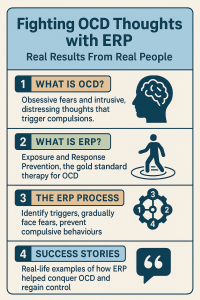
ERP therapy is structured, collaborative, and deeply empowering. It’s not about suppressing fears but learning to live alongside them—without letting them dictate your life.
Step 1: Identifying Triggers and Obsessions
Therapists start by mapping out what triggers obsessive fears. This could include specific thoughts, images, or situations. The process is gentle yet analytical, helping patients see patterns that drive their compulsions.
Step 2: Facing the Fear (Exposure)
Next, patients gradually confront these triggers in real life or imagination. For instance, someone terrified of accidentally harming someone might write “I might hurt someone” repeatedly until the anxiety naturally declines.
Step 3: Preventing the Compulsion (Response Prevention)
The key to ERP’s success lies here—patients learn not to perform the ritual. Instead, they sit with the discomfort, allowing their brain to adjust. Over time, the anxiety fades, and intrusive thoughts lose their grip.
Real Results From Real People: Stories of Transformation
ERP changes lives—not overnight, but consistently.
Case Study 1: From Daily Panic to Peace of Mind
Sarah, a 32-year-old teacher, struggled with contamination fears. After 12 weeks of ERP, she could use public restrooms without anxiety—something she hadn’t done in years.
Case Study 2: Overcoming Relationship OCD (ROCD)
Mark constantly questioned whether he truly loved his partner. ERP helped him sit with uncertainty instead of seeking reassurance. Six months later, his intrusive doubts subsided by 70%.
Case Study 3: From Intrusive Harm Thoughts to Freedom
Jenna, a young mother tormented by violent thoughts, feared she was dangerous. ERP helped her recognize these thoughts as false alarms. Today, she lives free of fear and guilt.
The Psychology Behind ERP’s Success
ERP’s effectiveness is grounded in neuroscience and learning theory.
Rewiring the Brain Through Exposure
Repeated exposure without compulsion helps the brain “unlearn” false danger signals—a process known as neuroplasticity. Fear centers in the brain shrink, while rational processing strengthens.
Building Tolerance for Uncertainty
ERP doesn’t promise absolute certainty—it trains the mind to live with uncertainty. This shift builds emotional resilience, crucial for long-term recovery.
ERP Therapy in Practice: What to Expect
ERP is not easy, but it’s profoundly effective.
Working with an OCD Specialist
Qualified therapists tailor ERP exercises to each person’s unique OCD profile. Organizations like the International OCD Foundation (IOCDF) provide directories of certified professionals.
At-Home ERP Exercises
For mild OCD, guided self-help ERP programs or digital platforms can be beneficial. However, severe cases should always involve a licensed therapist.
Common Challenges and How to Overcome Them
Discomfort and temporary spikes in anxiety are normal. The key is persistence—ERP teaches patients that temporary distress leads to lasting freedom.
Measuring Real Results: What Does Recovery Look Like?
Progress in ERP isn’t about “never having intrusive thoughts again”—it’s about changing your relationship with them.
Tracking Progress with Data and Feedback
Many therapists use structured tools like the Yale-Brown Obsessive Compulsive Scale (Y-BOCS) to track improvement over time.
Sustaining Gains After ERP
Ongoing mindfulness, self-compassion, and occasional “booster sessions” help maintain progress long-term.
ERP in the Digital Age: Apps, Online Therapy & AI Support
Digital tools now make ERP accessible worldwide.
ERP Mobile Apps and AI-Based Coaching
Apps like NOCD and GG OCD use AI and therapist-guided exposure plans to extend ERP beyond traditional therapy sessions.
Online Communities Sharing Real Results
Online support groups provide encouragement and accountability, proving that no one fights OCD alone.
FAQs About Fighting OCD Thoughts with ERP
1. How long does ERP take to work?
Most people notice significant improvement in 8–12 weeks with consistent practice.
2. Can ERP make OCD worse at first?
Temporary spikes in anxiety are normal—it’s a sign the brain is learning.
3. Is ERP suitable for all types of OCD?
Yes. ERP is effective across contamination, harm, sexual, and relationship OCD variants.
4. Can I do ERP on my own?
Mild cases may benefit from self-help, but professional guidance is ideal.
5. Is medication required with ERP?
Sometimes. SSRIs can complement ERP by reducing baseline anxiety.
6. How do I find a certified ERP therapist?
Visit iocdf.org/find-help for licensed OCD specialists.
Therapeutic And Expert Insights


