Table of Contents
ToggleOCD Therapy Treatment Complete Beginner’s Guide: Understanding, Managing & Overcoming OCD Naturally

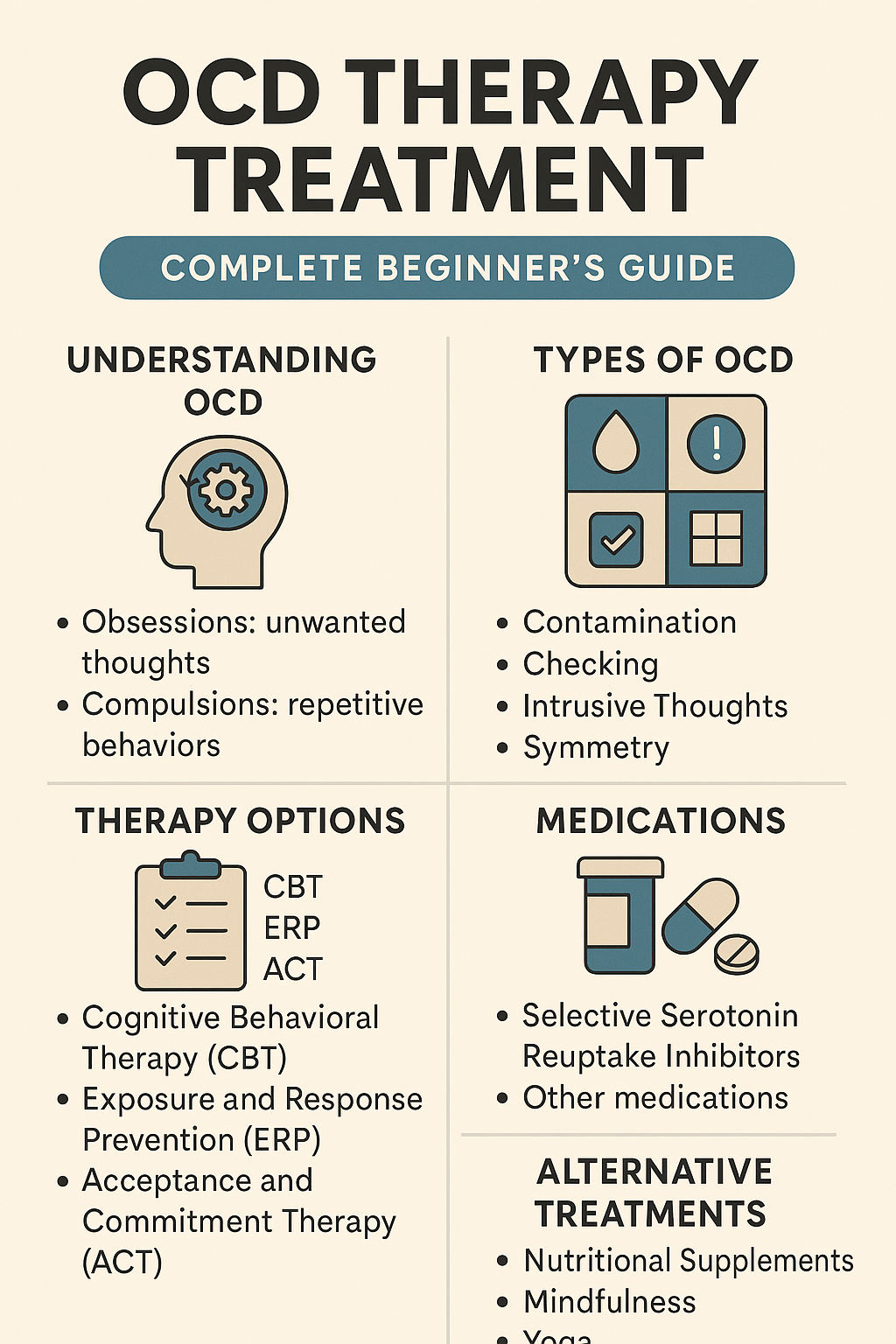
Discover the OCD Therapy Treatment Complete Beginner’s Guide — a step-by-step overview of OCD symptoms, causes, and the best therapies including CBT, ERP, ACT, medications, and holistic recovery methods.
What Is OCD?
Obsessive-Compulsive Disorder (OCD) is a mental health condition characterized by intrusive, unwanted thoughts (obsessions) and repetitive actions (compulsions). These behaviors are attempts to reduce anxiety or prevent perceived harm — but over time, they reinforce the disorder’s cycle.
OCD affects over 2% of the global population, impacting people of all ages. While the condition can feel overwhelming, understanding its mechanisms is the first step toward effective treatment.
Understanding Obsessions and Compulsions
Obsessions are persistent, anxiety-provoking thoughts or urges — such as fear of germs or harm.
Compulsions are repetitive behaviors or mental acts done to neutralize those fears — like excessive hand washing or checking.
The brain associates the compulsion with temporary relief, creating a feedback loop that strengthens OCD over time.
Common Types of OCD
| Type | Example |
|---|---|
| Contamination OCD | Fear of germs or disease, excessive cleaning |
| Checking OCD | Repeatedly checking doors, appliances, or locks |
| Symmetry OCD | Needing items perfectly aligned |
| Intrusive Thought OCD | Disturbing thoughts about harm, violence, or taboo topics |
| Hoarding OCD | Difficulty discarding possessions |
Understanding your specific OCD subtype helps tailor the right treatment plan.
How OCD Affects the Brain and Body
Research shows that OCD involves overactivity in the cortico-striato-thalamo-cortical (CSTC) circuit — a brain loop that regulates fear and decision-making. Neurotransmitters like serotonin and glutamate play major roles in this process.
The Role of Serotonin and Glutamate
Serotonin imbalances can intensify intrusive thoughts, while glutamate overactivity increases compulsive behaviors. This insight guides pharmacological treatments like SSRIs and glutamate-modulating drugs (e.g., memantine).
Stress and Brain Circuit Overactivity
Chronic stress amplifies the OCD cycle. Elevated cortisol levels can make the brain’s threat response hyperactive, sustaining anxiety and repetitive behavior loops.
Diagnosing OCD
A diagnosis involves a clinical interview, symptom inventory, and behavioral evaluation. Professionals use tools like the Yale-Brown Obsessive-Compulsive Scale (Y-BOCS) to gauge severity.
When to Seek Professional Help
If intrusive thoughts or compulsions interfere with work, school, or relationships, consult a psychologist or psychiatrist. Early diagnosis leads to faster, more effective treatment outcomes.
The Core of OCD Therapy Treatments
Cognitive Behavioral Therapy (CBT)
CBT helps identify distorted thinking patterns and replace them with balanced thoughts. For OCD, it’s especially effective when combined with Exposure and Response Prevention (ERP).
What to Expect in CBT Sessions
Therapy often involves identifying triggers, tracking intrusive thoughts, and challenging irrational beliefs through guided exercises.
Exposure and Response Prevention (ERP)
ERP is the gold standard for OCD treatment. It gradually exposes you to feared situations while preventing compulsive responses, teaching your brain that the anxiety will subside naturally.
Real-Life ERP Example
If someone fears contamination from touching doorknobs, ERP may involve touching one and refraining from washing hands immediately — allowing anxiety to decrease on its own.
Acceptance and Commitment Therapy (ACT)
ACT complements CBT by emphasizing acceptance over resistance. Patients learn to observe their thoughts non-judgmentally and commit to actions that align with their values rather than fear.
Medication for OCD: What You Should Know
While therapy remains the first line, medication can significantly reduce symptom severity for many individuals.
Commonly Prescribed OCD Medications
SSRIs: Sertraline (Zoloft), Fluoxetine (Prozac), Fluvoxamine (Luvox)
Clomipramine: A tricyclic antidepressant effective for severe OCD
SNRIs and Augmentations: Sometimes paired with antipsychotics for resistant cases
Possible Side Effects
Mild nausea, sleep changes, or mood shifts are common early on. Always work closely with your psychiatrist for dosage adjustments and safety monitoring.
Alternative and Natural OCD Treatments
Nutritional Support for OCD Relief
Magnesium: Calms the nervous system
Omega-3 fatty acids: Support serotonin function
Vitamin D: Regulates mood and brain chemistry
Mindfulness and Meditation Practices
Mindfulness-based therapy teaches detachment from intrusive thoughts, helping individuals observe thoughts without reacting to them.
Yoga and Breathwork
Regular yoga and controlled breathing techniques lower stress hormones and promote neural balance.
Modern Advances in OCD Therapy
Transcranial Magnetic Stimulation (TMS)
TMS uses electromagnetic pulses to stimulate brain regions linked to OCD. It’s FDA-approved and shows high success rates in reducing symptom severity.
Deep Brain Stimulation (DBS)
Reserved for severe cases, DBS implants electrodes in targeted brain areas to normalize abnormal activity. It’s a last-resort option but can transform lives.
Digital & App-Based Therapies
Apps like NOCD, MindEase, and GG OCD deliver guided ERP exercises, symptom tracking, and community support.
Self-Help Strategies for OCD
Setting Realistic Goals
Start small. Reduce one compulsion at a time, track your progress, and celebrate micro-wins.
Support Groups and Online Communities
Organizations like the International OCD Foundation (IOCDF) and online forums provide education and peer encouragement.
FAQs About OCD Therapy Treatments
1. What is the most effective treatment for OCD?
ERP-based CBT is the most evidence-backed approach for long-term improvement.
2. How long does it take to see results?
Therapy can show benefits within 8–12 weeks, depending on consistency and severity.
3. Do medications cure OCD?
No, but they help reduce symptoms enough to make therapy more effective.
4. Can OCD go away without treatment?
OCD rarely disappears on its own; professional intervention is highly recommended.
5. Is it safe to combine therapy with supplements?
Yes, but always consult your doctor to avoid drug interactions.
6. Are OCD apps reliable?
Many are clinically validated and can complement in-person therapy effectively.
Conclusion: Your Journey Toward Recovery
OCD is not a life sentence — it’s a challenge that can be managed with the right combination of therapy, medication, mindfulness, and lifestyle change. With consistency, support, and compassion, recovery is within reach.
If you’re just beginning your journey, remember: the first step is awareness, and the next is action. Modern science and digital innovation have made OCD therapy more effective and accessible than ever.
External Resource
For more information, visit the International OCD Foundation (IOCDF) or Harvard Health’s OCD Treatment Guide.
Related Posts
 Future of OCD Therapy
Future of OCD Therapy: Apps, and New Medical Approaches for a Digital Healing Revolution …
- Online Therapy for OCD
Online Therapy for OCD: Best Platforms Reviewed 2025 Guide Introduction: Understanding OCD and…
 How Exposure Therapy Helps You Break Free From OCD Rumination
How Exposure Therapy Helps You Break Free From OCD Rumination and Reclaim Inner Peace…
 Latest Research in OCD Therapy Treatments
Latest Research in OCD Therapy Treatments: 12 Breakthroughs, Big Wins & What’s Next Discover…