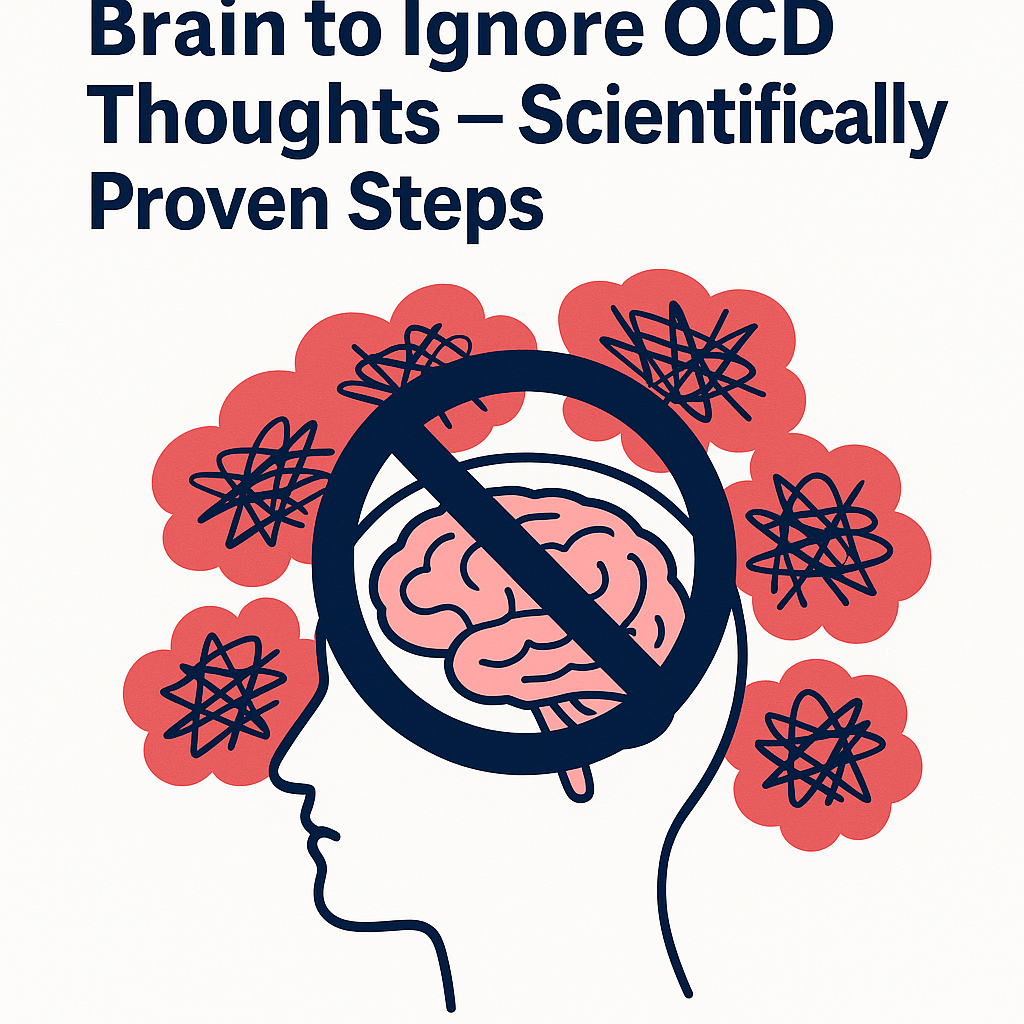
🧠 How to Train Your Brain to Ignore OCD Thoughts — Scientifically Proven Steps
Understanding OCD: The Science Behind Intrusive Thoughts

What Exactly Are OCD Thoughts?
Obsessive-Compulsive Disorder (OCD) is more than repetitive behaviors—it’s a complex neurological pattern that traps the brain in cycles of intrusive, unwanted thoughts and compulsive responses. OCD thoughts often manifest as fears, doubts, or impulses that clash with your values, leaving you anxious and compelled to “neutralize” them.
These intrusive thoughts are normal to some extent—most people have them occasionally. But for someone with OCD, the brain misfires the alarm system, interpreting harmless mental events as real threats. The result? Endless rumination and ritualistic behaviors that temporarily soothe anxiety but reinforce the cycle long-term.
How the Brain Creates and Responds to Intrusive Thoughts
Neuroscientifically, OCD involves overactivity in the cortico-striato-thalamo-cortical (CSTC) circuit, particularly in the orbitofrontal cortex and anterior cingulate cortex—regions tied to error detection and emotional regulation. Dopamine and serotonin imbalances also heighten this loop, making it difficult to disengage from obsessive thinking.
In short, your brain isn’t broken—it’s stuck in overdrive, mistakenly trying to “solve” a nonexistent problem. Understanding this helps you approach retraining with compassion rather than frustration.
Why You Can’t “Just Stop Thinking” These Thoughts
The Paradox of Suppression and Rebound Effect
Trying to forcefully suppress OCD thoughts only strengthens them. Research from Harvard psychologist Daniel Wegner on the “white bear effect” showed that the more you try not to think of something, the stronger it rebounds in your awareness. This paradox is central to OCD: resistance feeds the obsession.
The Role of Anxiety and Brain Chemistry in OCD
Anxiety acts as fuel for OCD. When a distressing thought arises, your brain perceives danger and floods your system with cortisol and adrenaline. This chemical surge makes the thought feel urgent, even though it’s not. Training your brain to ignore OCD thoughts begins by reducing your reactivity to them, not fighting them head-on.
Scientifically Proven Methods to Retrain Your Brain
Step 1: Recognize and Label OCD Thoughts Without Judgment
Awareness is the foundation of change. When an intrusive thought appears, practice labeling it:
“This is an OCD thought, not reality.”
By naming it, you activate the prefrontal cortex, the rational part of your brain, which reduces emotional charge and interrupts the automatic anxiety loop.
Step 2: Practice Exposure and Response Prevention (ERP) Therapy
ERP is the gold standard for OCD treatment. It involves exposing yourself to triggers without performing the compulsion that usually follows. Over time, your brain learns that nothing catastrophic happens when you resist the urge, effectively rewiring fear circuits through a process called habituation.
For example, if you fear contamination, you might intentionally touch a “dirty” surface and resist washing your hands. The discomfort will peak and then naturally decline, teaching your brain safety through experience.
Step 3: Build Cognitive Flexibility Through Mindfulness
Mindfulness trains your attention to stay in the present moment without judgment. Scientific studies show that mindfulness meditation decreases activity in the default mode network (DMN)—the part of the brain associated with rumination. Try daily practices like mindful breathing or body scans for 10–15 minutes.
Step 4: Rewire Neural Pathways with Habit Reversal Techniques
Each time you resist a compulsion or choose a new behavior, your brain forms new neural connections. Using habit reversal training, you replace compulsions with alternative, neutral actions. For instance, instead of checking a lock repeatedly, you might journal your urge and delay the check for 15 minutes.
Step 5: Strengthen Emotional Regulation via Breathing and Relaxation Exercises
Controlled breathing lowers cortisol and calms the amygdala, the brain’s fear center. Techniques like 4-7-8 breathing, progressive muscle relaxation, or guided imagery teach your body to relax, making obsessive thoughts lose their grip.
Supporting Brain Retraining with Lifestyle Changes
Nutrition and Exercise for Mental Clarity
A balanced diet rich in omega-3 fatty acids, B vitamins, and antioxidants supports neurotransmitter balance. Regular exercise boosts serotonin and dopamine, naturally improving mood and resilience against obsessive thinking.
Sleep and Its Role in Cognitive Rebalancing
During deep sleep, your brain performs neural pruning, clearing away unneeded connections. Poor sleep strengthens obsessive loops. Aim for 7–9 hours nightly with consistent sleep schedules.
Reducing Caffeine, Alcohol, and Digital Overstimulation
Caffeine and alcohol can spike anxiety and worsen intrusive thoughts. Similarly, excessive screen time—especially social media—keeps your nervous system in “fight or flight” mode. Limit these stimuli to create mental space for healing.
Professional Help: When and How to Seek It
Cognitive Behavioral Therapy (CBT) and ERP Specialists
If OCD significantly interferes with daily life, professional guidance is crucial. Look for CBT-trained therapists specializing in ERP. They provide structured, evidence-based plans to guide exposure safely and effectively.
Medication Options for OCD Thought Management
SSRIs (like fluoxetine and sertraline) and other antidepressants help balance serotonin levels and reduce obsessive intensity. Medication, when combined with therapy, has been shown to accelerate brain retraining.
How to Find Evidence-Based Treatment Near You
Use resources such as the International OCD Foundation (IOCDF) to locate certified specialists in your area.
Real-Life Success Stories and Case Studies
Studies show up to 60–80% of patients experience significant improvement with ERP therapy combined with mindfulness and lifestyle adjustments. People report gaining mental clarity, reduced compulsions, and greater emotional stability—all achievable through consistent brain retraining.
FAQs About Training Your Brain to Ignore OCD Thoughts
1. Can OCD thoughts go away completely?
They can significantly decrease with therapy, but occasional intrusive thoughts are normal. The goal is to reduce their power, not eliminate them entirely.
2. How long does brain retraining take?
Most people notice improvement in 8–12 weeks with daily practice and professional guidance.
3. Can meditation make OCD worse?
Mindfulness helps most people, but “over-monitoring” your thoughts can backfire. It’s best practiced under a therapist’s supervision initially.
4. Is medication necessary?
Not always. Mild to moderate OCD can be managed with ERP and lifestyle changes, but medication can enhance results when symptoms are severe.
5. What’s the difference between intrusive thoughts and real desires?
Intrusive thoughts are ego-dystonic (against your values), while genuine desires align with your beliefs. OCD thrives on confusing the two.
6. Can I train my brain without therapy?
Yes, to an extent. Self-help techniques like mindfulness, journaling, and gradual exposure help—but therapy accelerates progress and ensures safety.
Conclusion: Taking Control of Your Mind with Science
Training your brain to ignore OCD thoughts isn’t about suppression—it’s about re-education. Through mindfulness, ERP therapy, habit reversal, and lifestyle optimization, you can teach your brain that intrusive thoughts don’t define you.
Remember, every time you face your fears without reacting, you’re rewiring your neural circuitry toward peace and resilience.


